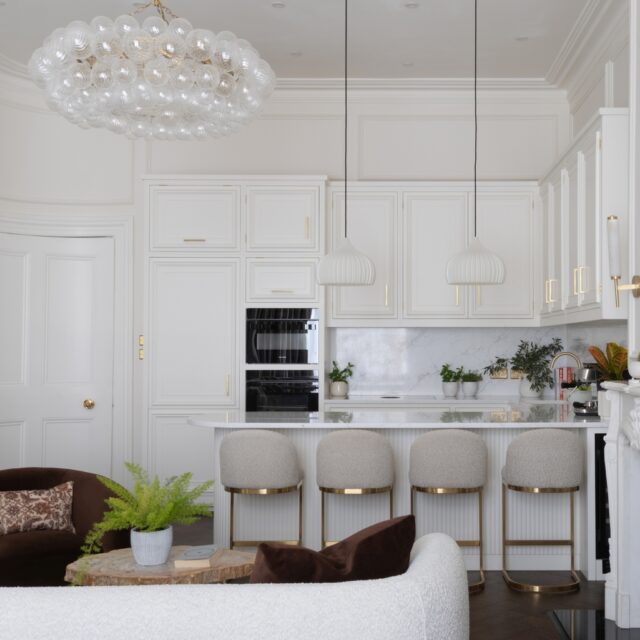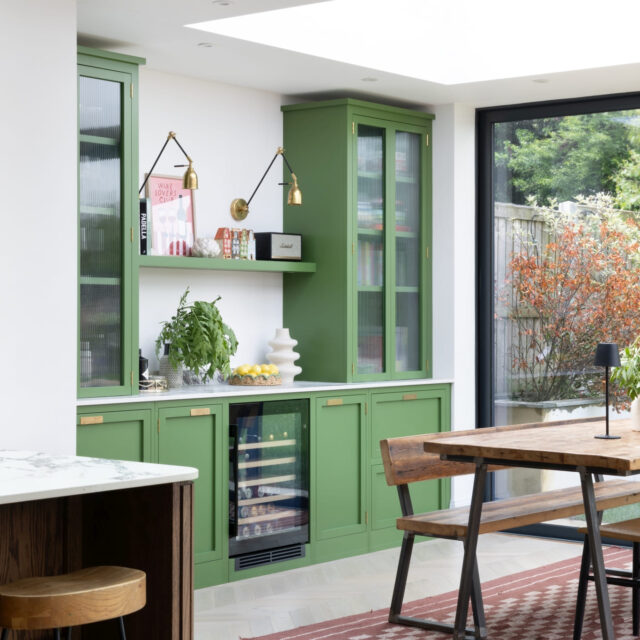
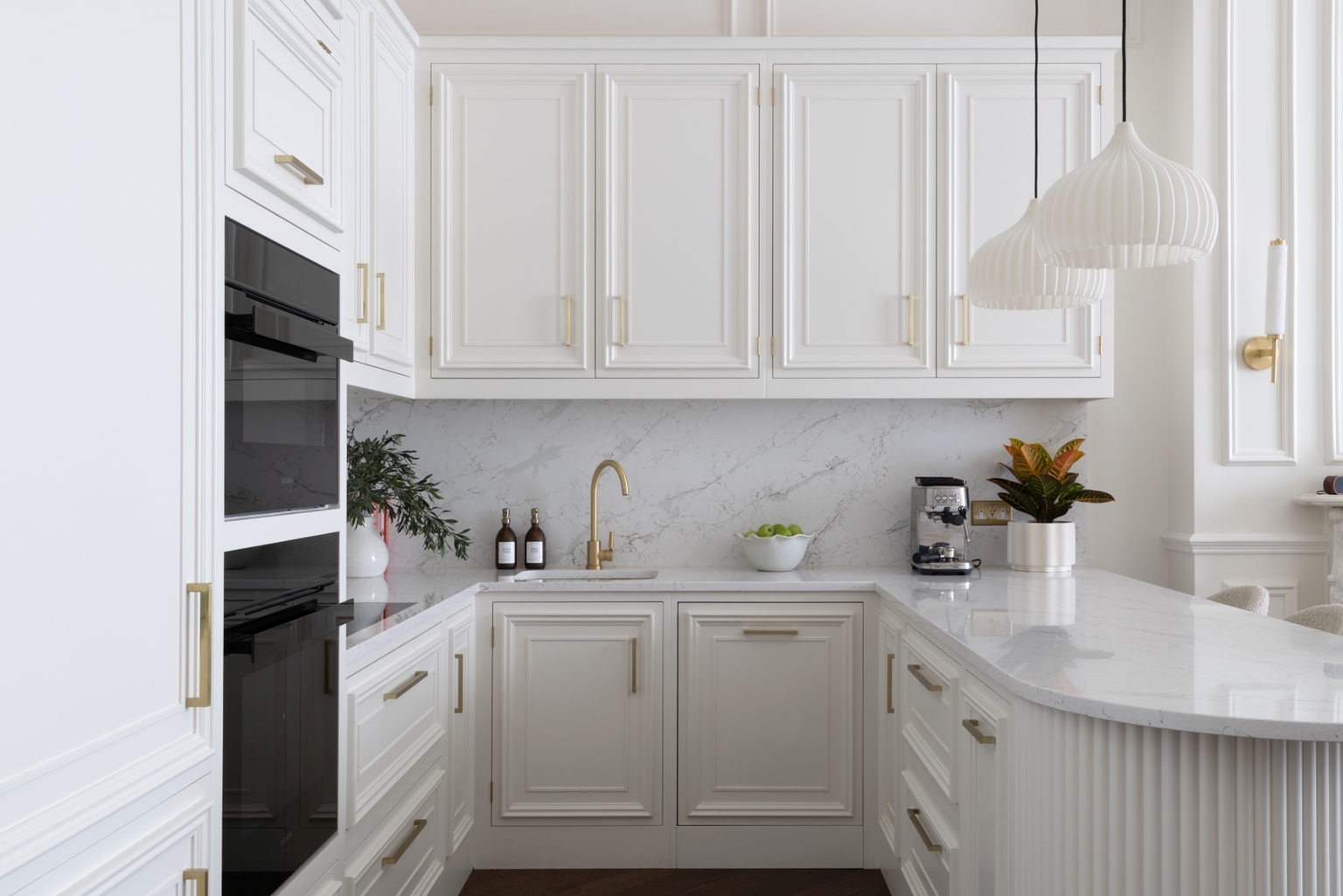
If you look closely at almost any kitchen that was not made specifically for the room it sits in, you will find filler strips. These narrow pieces of material, matched to the cabinet door colour, are used to fill the gaps between standard-sized units and the walls, corners, and architectural features that do not align with standard dimensions.
Filler strips are not inherently a defect. They are a practical solution to the problem of fitting standardised cabinets into non-standard rooms. But they are one of the clearest visual markers of the difference between a kitchen made for a room and a kitchen installed in one.
At Higham Furniture, filler strips are not used, because there is no need for them. This article explains why.

Why Filler Strips Exist
Kitchen cabinets manufactured at volume are produced in standard widths, typically in 100mm increments from 300mm to 900mm for base units and 300mm to 1000mm for wall units. The available sizes are fixed by the production process.
When a kitchen installer arrives at a room, the likelihood that the wall-to-wall dimension of the kitchen corresponds exactly to a combination of standard unit widths is low. The gap between what the cabinets add up to and what the room is actually wide is filled with a filler strip, a piece of material in the same finish as the cabinetry.
In a well-executed installation, filler strips are neat and relatively inconspicuous. But they are always visible to a practised eye, and they always represent a point at which the room compromised to accommodate the cabinets rather than the other way around.
Why Bespoke Kitchens Do Not Need Filler Strips
In a genuinely bespoke kitchen, every cabinet is designed to the exact dimensions of the room. If the wall-to-wall dimension is 3,247mm and the kitchen design calls for four base units, those four units are designed with widths that add up to 3,247mm, less the depth of any end panels. There are no standard sizes to work from, and therefore no gaps to fill.
The same applies to corners, architectural features, and any other dimensional condition that a standard cabinet range cannot accommodate cleanly. At Higham Furniture, if your kitchen has a chimney breast, an original recess, or a wall that is not perfectly square, the cabinetry is designed around those conditions exactly. There are no approximations.
This is one of the most tangible expressions of what bespoke means in kitchen design. For a broader discussion of what the term genuinely means and how to verify it, see our article on what bespoke actually means in kitchen design.

What Filler Strips Tell You About a Kitchen
The presence of filler strips is one of the clearest signals that a kitchen was not made specifically for the room. It does not mean the kitchen is poor quality in other respects, it simply means it was made to standard dimensions and fitted to an approximation of the room’s actual measurements.
For a kitchen investment at the level that Higham Furniture works in, the expectation should be that the cabinetry was designed and made for the specific room. The absence of filler strips is a baseline quality indicator, not a premium feature.
Starting Your Kitchen with Higham Furniture
Every Higham kitchen is made to the exact dimensions of your room. The process begins with a measured survey that documents every relevant dimension, feature, and condition of the space. The design is generated from those measurements, not from a standard catalogue of unit sizes.
Book a design call to start the process.
 Frequently Asked Questions
What are filler strips in a kitchen?
Filler strips are narrow pieces of material, matched to the cabinet door colour or finish, used to fill gaps between standard-sized kitchen units and the walls, corners, or other features of a room. They are used in kitchens assembled from standard-sized units where the available cabinet widths do not add up exactly to the room’s actual dimensions.
Are filler strips a sign of a bad kitchen installation?
Not necessarily a bad installation, but they are a sign that the kitchen was not made specifically for the room. A well-executed installation using standard units will use filler strips neatly and inconspicuously. A genuinely bespoke kitchen made to the room’s exact dimensions does not need them.
How can I tell if a kitchen has filler strips?
Look at the junctions between cabinets and walls, particularly at the ends of runs. Filler strips appear as narrow vertical strips of material, usually matching the cabinet colour, between the end cabinet and the wall. They may be a few millimetres or several centimetres wide depending on the dimension gap.
Is a kitchen without filler strips always bespoke?
The absence of filler strips is a necessary but not sufficient indicator of genuinely bespoke construction. Some companies produce semi-custom kitchens with a wider range of available unit widths that reduce the need for fillers. A genuinely bespoke kitchen has no fillers because every cabinet is designed and built to the room’s exact dimensions.
Does the absence of filler strips add to the cost of a kitchen?
Not directly. The cost of a genuinely bespoke kitchen reflects the cost of designing and making cabinetry specifically for a room. The absence of filler strips is a consequence of that process rather than an additional feature. It is one of the baseline quality standards that bespoke construction delivers.
Written by the Higham Furniture design team. Higham Furniture is an award-winning cabinetmaker based in Denmead, Hampshire, with a design studio in Fulham, London. Tim Higham and his team have been designing and building bespoke handmade kitchens for discerning homeowners across London and the South East.