The price of a handmade kitchen is determined by eight core factors: the materials used in the carcasses and doors, the complexity of the design, the type of construction (in-frame versus overlay), the quality of the hardware, the paint or stain finish, the size and layout of the room, the level of bespoke detailing, and the installation requirements. Understanding each of these gives you a genuine framework for evaluating any kitchen quote, and for understanding why two kitchens that look similar on a showroom floor can differ by tens of thousands of pounds.
At Higham Furniture, we build every kitchen from scratch in our Denmead, Hampshire workshop and design from our studio in Fulham, London. Because we sell direct, without a high-street showroom adding cost between the workshop and your home, the price you pay reflects actual materials, craftsmanship, and design time. This article breaks down each cost factor so you can make informed decisions about where to invest and where to save.
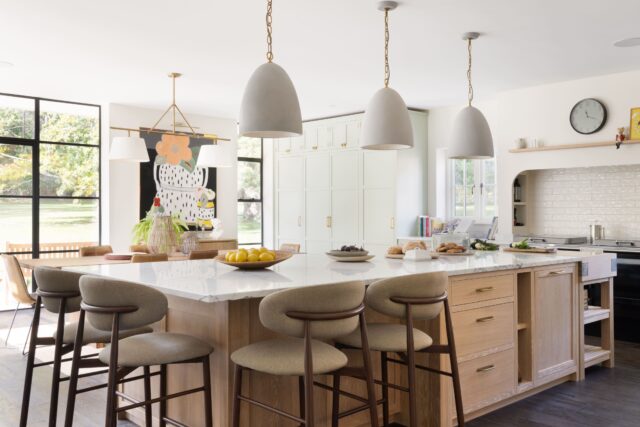
What Materials Are the Cabinets Made From?
The single most significant cost factor in any handmade kitchen is what the cabinets are actually built from. This is also where the biggest quality gap exists between makers, and where misleading marketing does the most damage.
At the budget end, you will find MDF carcasses, medium-density fibreboard that is relatively cheap to produce and easy to machine. MDF is adequate for factory-produced kitchens with shorter expected lifespans, but it does not hold screws as well over time, it swells when exposed to moisture, and it does not age in the way real timber does.
At the premium end, the standard is oak-veneered plywood. This is the material Higham Furniture uses for carcass construction. Plywood is dimensionally stable, resistant to warping, holds fixings securely over decades, and provides a real timber interior that looks and feels substantially different from a foil-wrapped MDF box. The cost difference between an MDF carcass kitchen and an oak-veneered plywood kitchen of identical dimensions can be 20–30% on the cabinetry alone.
Doors and drawer fronts add another layer. Solid timber frame-and-panel doors cost more than MDF slab doors, but they are also more repairable, more durable, and more resonant when you close them — a detail that sounds minor until you live with the kitchen daily for twenty years.
How Complex Is the Design?
A simple single-wall kitchen with standard cabinet sizes and a straightforward layout is significantly less expensive than a complex open-plan design with an island, a pantry, integrated seating, and cabinetry that wraps around architectural features.
Design complexity affects cost in two ways. First, more complex designs require more design time. A skilled kitchen designer, the kind who works at Higham’s Fulham studio, will spend weeks on a complex project: measuring, drawing, revising, specifying, coordinating with architects and builders. That time has a real cost.
Second, complex designs produce more complex cabinetry. Curved units, angled corners, bespoke larder cupboards with internal fittings, and cabinetry built around period features all require more workshop hours than a row of standard base units. Each bespoke element adds to the build time and the material usage.
The lesson for buyers is straightforward: complexity is worth paying for when it solves a genuine spatial or functional problem. A well-designed pantry that transforms how you store and cook is money well spent. Decorative complexity for its own sake is not.
In-Frame or Overlay Construction?
This is one of the most significant cost distinctions in kitchen cabinetmaking, and one that many buyers do not fully understand until they see both methods side by side.
In an overlay kitchen, the doors sit on the front of the cabinet box and overlap the frame. This is simpler to manufacture and more forgiving of minor dimensional variations. Most mid-range and some premium kitchens use overlay construction.
In an in-frame kitchen, the doors sit within the frame of the cabinet, with a precise gap around the edges. This is a hallmark of traditional British cabinetmaking and requires significantly more precision, more material, and more workshop time. Every door must be individually fitted to its frame opening, and the tolerances are measured in fractions of a millimetre.
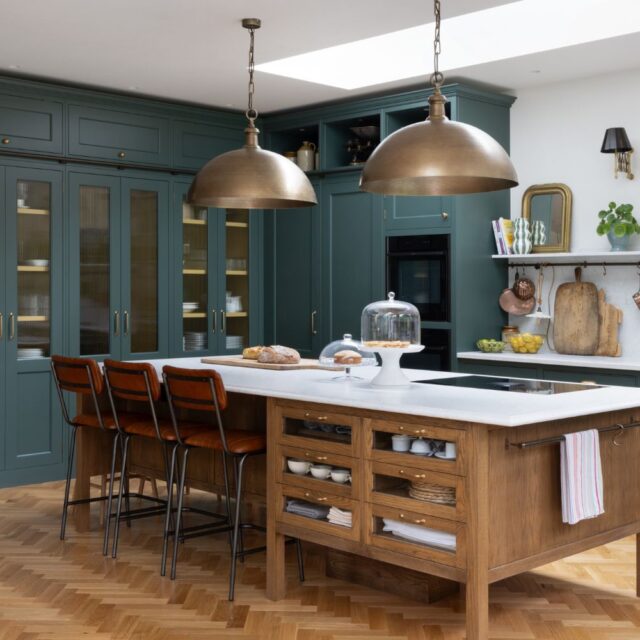
Higham Furniture’s award-winning Putney Painted Oak Framed Shaker Kitchen, which won the British Design and Manufacturing Award at the Designerati Awards UK 2025, is an in-frame design. The difference in visual quality and tactile feel between in-frame and overlay is immediately apparent, and it is one of the clearest markers of a genuinely premium kitchen.
In-frame construction typically adds 15–25% to the cost of the cabinetry compared to an equivalent overlay kitchen. For many buyers, it is the single most worthwhile upgrade.
What Hardware Goes Inside?
Hardware is the mechanical heart of a kitchen: hinges, drawer runners, internal fittings, pull-out mechanisms, and soft-close systems. It is also one of the areas where less scrupulous makers cut costs without the buyer noticing, at least not immediately.
Premium hardware from manufacturers such as Blum, Grass, or Häfele is engineered to operate smoothly for 20–30 years of daily use. A Blum Tandembox drawer runner, for example, is rated for over 70,000 open-close cycles. Budget hardware from unknown manufacturers may look similar when new but will degrade noticeably within a few years.
The cost difference on a full kitchen is meaningful. Specifying premium soft-close hinges, full-extension drawer runners, and quality internal fittings throughout a medium-sized kitchen adds several thousand pounds compared to budget alternatives. But this is one of the areas where economy is genuinely false, replacing failed drawer runners or seized hinges after five years is expensive, disruptive, and avoidable.
At Higham, we use quality hardware as standard across every kitchen. It is not an optional upgrade, because a kitchen built to last three decades requires components that will last three decades.
How Is the Kitchen Finished?
The paint or stain finish on a kitchen is one of the most visible quality markers, and one of the most significant cost variables.
Factory-sprayed finishes, applied in a production booth and baked on, are consistent, fast, and relatively inexpensive. They look sharp on day one. But they are also harder to repair if chipped or scratched, and they tend to show wear patterns around high-use areas within five to ten years.
Hand-painted finishes, applied by a skilled painter in a workshop environment, cost more in labour hours but produce a different result. The paint builds up in subtle layers, sanding between coats, producing a depth and texture that spray finishes cannot replicate. Hand-painted surfaces can also be touched up and refreshed over time, extending the life of the kitchen significantly.
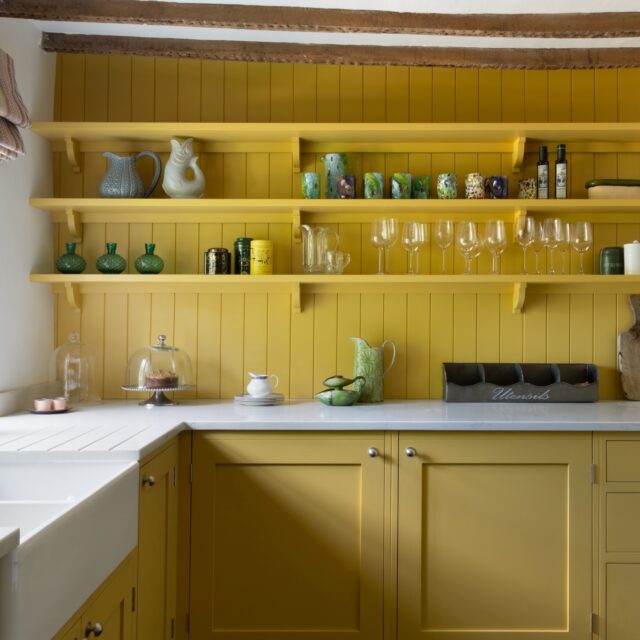
Tim Higham’s workshop in Denmead, Hampshire applies hand-painted finishes using premium paints, with multiple coats and sanding between each layer. The process takes considerably longer than spray application, a large kitchen can require two to three weeks of finishing work, but the result is a surface that ages gracefully rather than deteriorating.
The cost difference between a spray-finished kitchen and a hand-painted kitchen of the same design can be 10–20% of the total project cost. For a kitchen expected to last twenty years or more, many Higham clients consider this among the most important investments they make.
How Large Is the Kitchen and What Layout Does It Need?
Size is the most intuitive cost factor, but it operates in ways that are not always obvious. A larger kitchen uses more material and more labour, but the relationship is not strictly linear.
A compact galley kitchen in a London flat might require 10–12 cabinets. A large open-plan kitchen-diner in a detached house in Surrey or Hampshire might require 30–40 cabinets plus an island, a larder, and a utility run. The material and build cost scales roughly with the number of cabinets, but design time, finishing time, and installation time all increase disproportionately with complexity.
Layout also matters. An L-shaped kitchen is relatively efficient to design and build. A U-shaped kitchen with an island introduces more corner junctions, more scribing to uneven walls, and more coordination between different runs. A kitchen that wraps around a period chimney breast or navigates an irregular floor plan, common in London’s Victorian and Edwardian housing stock, requires bespoke solutions at every turn.
Higham Furniture designs kitchens across London, Surrey, Hampshire, and the Home Counties. We work regularly in period properties in Fulham, Chelsea, Kensington, Wandsworth, Putney, Wimbledon, and Chiswick, where no two rooms are the same shape and standard cabinet sizes are rarely an option. This is exactly the scenario where a bespoke cabinetmaker adds value that a showroom retailer cannot.
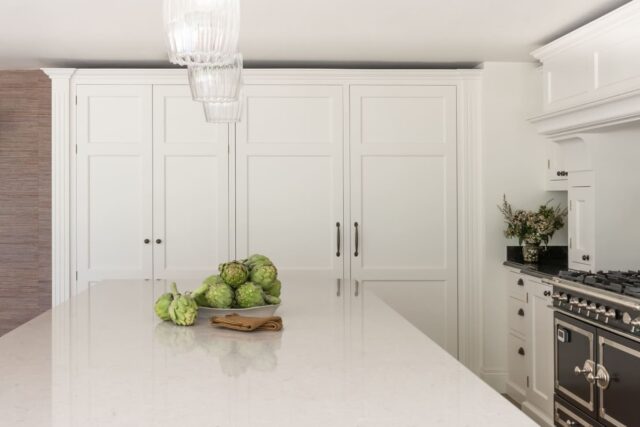
How Much Bespoke Detailing Is Involved?
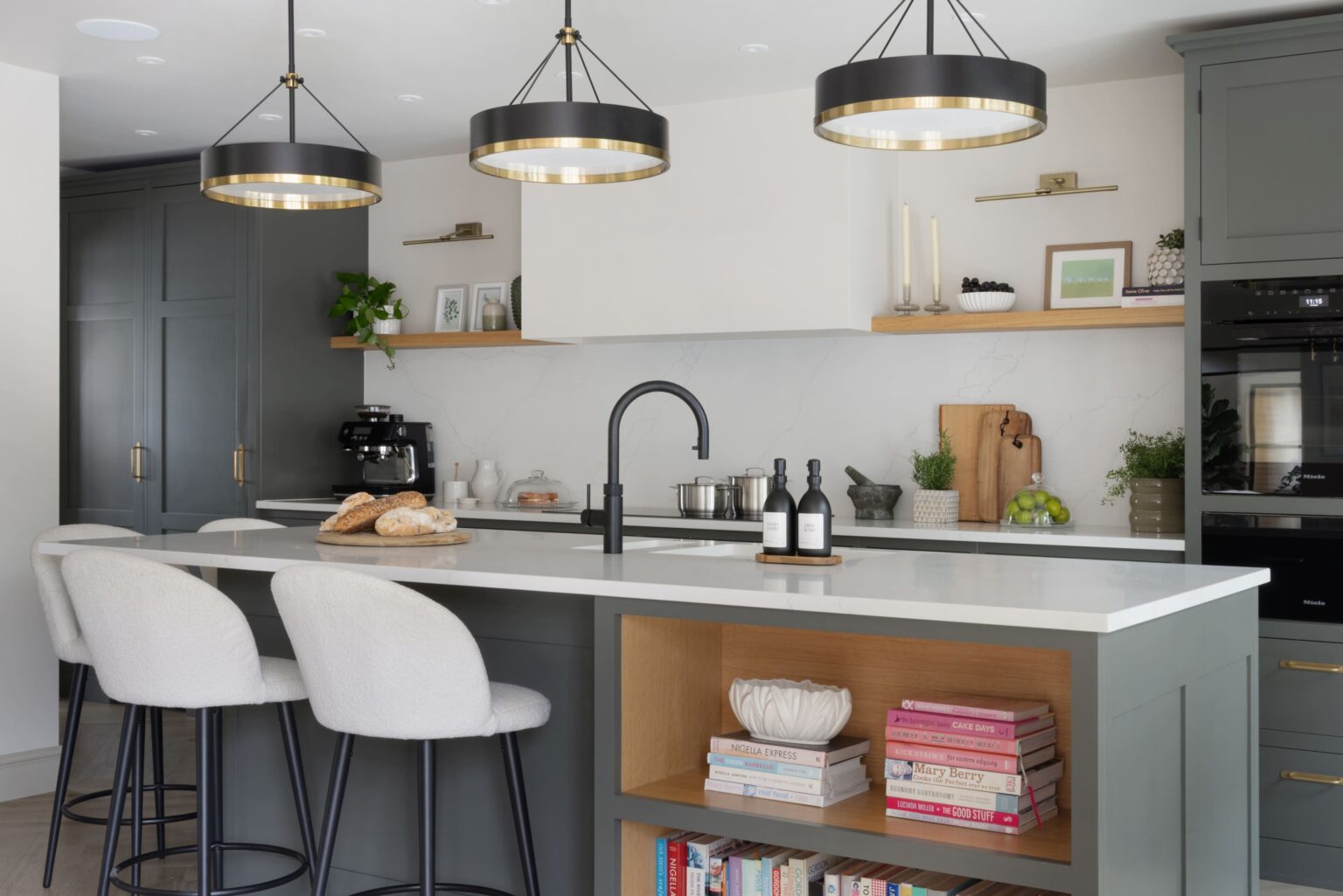
Beyond the basic cabinetry, bespoke detailing is where a handmade kitchen truly diverges from a factory-produced one. This includes elements like hand-crafted cornices and pilasters, integrated plate racks, spice drawers built to specific jar dimensions, curved end panels, bespoke mantel shelves over range cookers, and cabinetry designed around specific appliance configurations.
Each of these elements is designed and built individually in the workshop. There is no catalogue to order from, they are drawn, made, and fitted specifically for your kitchen. The cost per element is modest in the context of a full kitchen project, but the cumulative effect on both the total price and the finished result is significant.
This is also where the direct relationship with the cabinetmaker becomes most valuable. At Higham, clients can discuss bespoke detailing directly with the people who will build it. There is no sales layer interpreting the brief, no factory receiving a specification sheet. If you want a drawer designed to hold a specific set of knives, you discuss it with the person who will make that drawer.
The level of bespoke detailing is one of the key reasons Higham kitchens sit at the upper end of the premium market. Greater design complexity, finer craftsmanship detail, and the direct cabinetmaker relationship produce a result that simply is not achievable through a standard showroom model.
What Does Installation Require?
Installation is often underestimated in kitchen budgets, but it is a substantial element of both the cost and the quality of the finished result.
A handmade kitchen is not flat-pack furniture. It arrives from the workshop in large, finished components that must be precisely positioned, levelled, scribed to uneven walls, and connected. In-frame doors must be individually adjusted on site. Cornices and pilasters must be fitted and finished. Every joint must be tight, every line must be true.
A typical Higham installation takes one to two weeks on site, carried out by experienced fitters who understand how the kitchen was built, because they work closely with the same workshop that made it. This continuity between maker and installer is a quality safeguard that is lost when a showroom brand subcontracts installation to a separate team.
Installation costs also vary with site conditions. A straightforward ground-floor kitchen in a new-build requires less site work than a first-floor kitchen in a Georgian townhouse with uneven walls, sloping floors, and restricted access. London properties, particularly in areas like Kensington, Chelsea, and Muswell Hill, frequently present installation challenges that add time and cost.
Installation typically represents 8–12% of the total kitchen project cost. It is one of the areas where cutting corners has the most visible consequences, a beautifully made kitchen poorly installed will never look or feel right.
Why Understanding These Factors Matters
The purpose of breaking down these eight cost factors is not to make a handmade kitchen sound complicated or inaccessible. It is to give you the knowledge to evaluate what you are being quoted for and to make confident decisions about where your budget delivers the most value.
A handmade kitchen is a significant investment. It is also one that pays dividends over decades, in daily pleasure, in the value it adds to your home, and in the simple durability of something built properly from good materials by skilled hands.
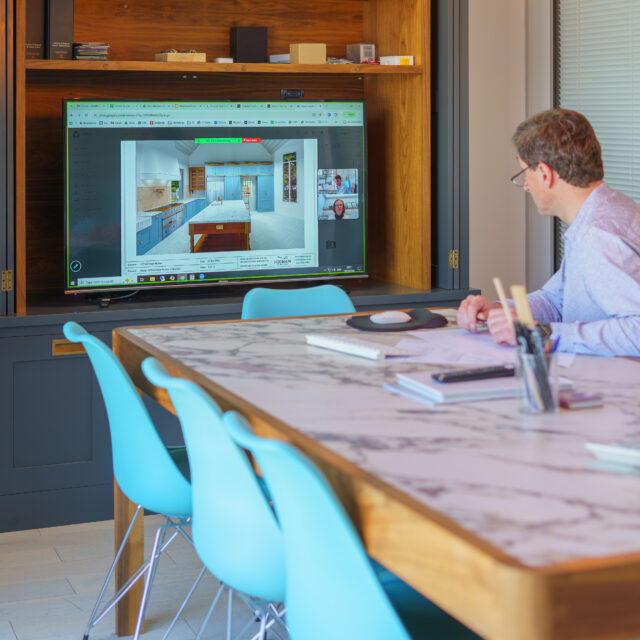
If you are beginning to think about a kitchen project and want to understand how these cost factors apply to your specific space, a 30-minute design call is the simplest way to get clarity. At Higham Furniture, we offer a free consultation by phone, video, or in person at our Fulham studio. No obligation. No showroom pressure. Just a clear, informed conversation about your project, your priorities, and your budget.

Frequently Asked Questions
What is the biggest factor in the cost of a handmade kitchen?
The materials used in construction, particularly the choice between MDF and oak-veneered plywood for carcasses, represent the single most significant cost variable. After materials, the type of construction (in-frame versus overlay) and the complexity of the design are the next most influential factors.
Why does in-frame construction cost more than overlay?
In-frame construction requires doors to be individually fitted within the cabinet frame to tolerances measured in fractions of a millimetre. This demands more material, more precision, and significantly more workshop time. It typically adds 15–25% to the cabinetry cost compared to overlay construction.
Does the paint finish really affect the price that much?
Yes. A hand-painted kitchen requires multiple coats with sanding between each layer, often taking two to three weeks for a large kitchen. This costs 10–20% more than a factory-sprayed alternative, but produces a surface that ages better, repairs more easily, and has a depth of finish that spray application cannot match.
How does room size affect the cost of a bespoke kitchen?
Cost scales roughly with the number of cabinets required, but design complexity, layout challenges, and installation difficulty can increase costs disproportionately. A compact galley kitchen with 10–12 cabinets costs significantly less than an open-plan layout with 30–40 cabinets, an island, and bespoke detailing throughout.
What should I budget for kitchen hardware?
Premium hardware from manufacturers like Blum or Grass adds several thousand pounds compared to budget alternatives across a full kitchen, but it is rated for 20–30 years of daily use. Higham Furniture uses quality soft-close hinges and full-extension drawer runners as standard across every project.
Can I save money by choosing simpler detailing?
Reducing bespoke detailing, such as opting for standard end panels instead of curved ones, or choosing simpler internal fittings, is one of the most effective ways to manage costs without compromising on core quality. A good designer at Higham Furniture’s Fulham studio can help you identify which details deliver the most impact for your budget.