When you compare a bespoke kitchen from a dedicated cabinetmaker with one sold through a high-street showroom, the price difference rarely reflects the difference in what you receive. A showroom kitchen bundles significant retail overhead into the ticket price: prime-location rent, display-model depreciation, multiple layers of sales commission, brand marketing, and head-office margin.
A bespoke kitchen from a maker like Higham Furniture bundles almost none of that. What you pay for is the kitchen itself: the timber, the joinery, the design hours, the workshop labour, and the installation. Understanding that distinction is the single most useful thing a London homeowner can do before committing to a £50,000+ project.
This guide breaks down where your money actually goes in each model, why two superficially similar quotes can represent very different products, and how to read a kitchen price with a more informed eye. For more kitchen inspiration and design ideas, visit our homepage.
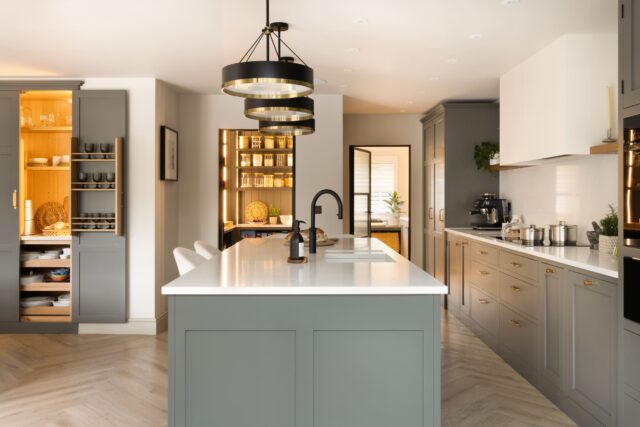
The Short Answer: Two Different Business Models, Two Different Price Stacks
A high-street showroom sells kitchens as a retail product. The showroom itself is the marketing. The business model depends on converting foot traffic in an expensive location, which means every kitchen sold has to carry a share of that cost.
A direct-from-maker cabinetmaker, by contrast, sells kitchens as a manufactured product. There is no showroom floor to subsidise. Design happens in a studio, making happens in a workshop, and the price reflects those two activities plus materials.
Higham Furniture runs a design studio in Fulham, London and a dedicated workshop in Denmead, Hampshire – and operates on this second model.
The result is not a cheaper kitchen. Higham kitchens sit firmly in the premium bracket, and are often more expensive than the mid-market showroom brands because the design complexity, cabinetmaking detail, and materials are of a higher standard. The result is a different value proposition: more of your money ends up in the product, less in the overhead. Explore our recent kitchen projects to see how these ideas have been brought to life.
What You’re Actually Paying For in a High-Street Showroom Kitchen
A typical high-street showroom kitchen price is made up of roughly the following components, though the exact split varies by brand:
Retail overhead. Showrooms in central London, the Home Counties, and affluent South East towns carry rents that need to be recovered across a relatively small number of projects per year. Shop-fit, utilities, staffing, and the lifecycle of the display kitchens themselves (replaced every few years to stay current) all load onto the unit cost of each sale.
Sales commission. Showroom staff are typically incentivised on the size of the quote. This creates pressure to upsell and an interest in the closing price rather than the built result.
Brand and marketing spend. Large showroom chains run national advertising, glossy brochures, sponsorships, and partnerships. These are genuine costs, they just don’t build anything into your kitchen.
Manufacturing is often outsourced. Many showroom brands do not make their own cabinets. The “bespoke” offer is assembled from a modular carcass range with bespoke fronts, painted and finished by a third party. The maker rarely meets the client.
Margin for the showroom owner and, if it’s a chain, head office. This is usually layered on top of every other cost.
The design fee, the cabinetry, the worktop, and the installation are in there too, but they can represent a surprisingly small share of the total. A client who pays £70,000 through a showroom chain may find that only a fraction of that figure reflects what’s actually been built.
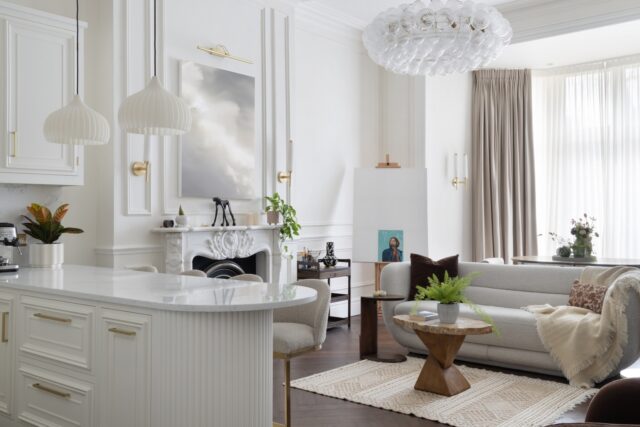
What You’re Actually Paying For in a Direct-From-Maker Bespoke Kitchen
A handmade kitchen from a cabinetmaker like Higham is priced against a different stack. The major cost lines are:
Design. Bespoke design hours with a specialist who understands both the space and the joinery. At Higham this starts with a 30-minute design call and moves, for committed clients, into detailed layout, cabinetry, and material development.
Cabinetmaking. Real workshop labour is cabinetmakers, sprayers, and finishers building the kitchen to the exact dimensions of the room. Every cabinet made to order, rather than drawn from a stock range.
Materials. Solid timber for frames and mouldings, oak-veneered plywood carcasses rather than MDF, hand-applied paint finishes, quality hinges and drawer runners, and the worktop specified.
Installation. Skilled fitters who know the cabinetry because it came out of the same workshop.
A modest margin for the business. Enough to sustain the workshop, the studio, and the team. Not enough to underwrite a high-street retail estate.
What’s missing from this list is as important as what’s on it: there is no showroom rent, no display-kitchen depreciation cycle, no sales commission structure, and no brand-level marketing overhead of the scale a national chain carries.
Higham’s Denmead workshop is a working building, not a shop window. The Fulham studio is a consultation space where clients and the design team can sit down with drawings and material samples. Neither exists to sell by footfall.
Why the Showroom Model Inflates the Sticker Price Without Improving the Kitchen
A showroom visit feels like due diligence. You can touch the doors, open the drawers, and see the lighting. That experience has real value — but the question to ask is whether it’s worth the premium you pay to fund it.
Showroom displays are marketing environments. The lighting, the props, the worktops, and the appliances are chosen to photograph well and sell well.
They are not necessarily representative of what will be installed in your home, and the “from” prices quoted on the floor almost never reflect the final quote after bespoke changes, upgrades, and optional extras are specified.
More importantly, a showroom cannot show you the thing that most distinguishes a well-made kitchen from a poorly made one: the construction. The frame, the joinery, the drawer box, the back panel, and the paint finish under a magnifying lens are what separate a kitchen that looks beautiful on installation day from one that still looks beautiful twenty years later.
A cabinetmaker’s workshop shows you those details. A retail display usually hides them.
The Direct-From-Maker Advantage, in Practical Terms
Buying direct from the cabinetmaker changes several things beyond price:
You speak to the people making the kitchen. There is no translation layer between a showroom salesperson and a factory you will never see. At Higham, the designer knows the workshop, and the workshop knows the designer. Clients can visit Denmead to see their kitchen being built.
Design decisions are made with the maker’s knowledge in the room. If a detail is expensive to make, you hear about it early. If a detail is easy to build and would significantly improve the finished kitchen, the designer will suggest it. This is how good bespoke design happens and it’s hard to replicate through a sales layer.
Problems get solved faster. On a bespoke project, something always needs a decision, a wall that isn’t quite square, a beam that intrudes half an inch, an appliance that arrived with different dimensions than the spec sheet said.
When the design studio, the workshop, and the installation team are under one roof, these decisions are made quickly and intelligently. When they’re spread across a showroom, a third-party manufacturer, and a contracted fitting team, they are slower and more expensive to resolve.
Why Higham Is Often More Expensive Than Mid-Market Showroom Brands
It’s worth being direct about this: a Higham kitchen is not the cheapest way to buy a handmade-style kitchen in London. Brands further down the market offer in-frame and shaker kitchens at lower price points, and they have legitimate businesses with satisfied clients.
What Higham costs more for is design complexity, cabinetmaking detail, and materials. The company’s signature in-frame shaker construction is genuinely hand-built, not a modular carcass with a shaker-style door added. The painted finishes are applied in the workshop with the depth and evenness that comes from doing this every day.
he carcasses are oak-veneered plywood, not MDF. The award-winning Putney Painted Oak Framed Shaker Kitchen, which won the British Design and Manufacturing Award at the Designerati Awards UK 2025, is representative of that standard of making, not an outlier.
If you are comparing a Higham quote to a lower-priced bespoke-style kitchen, the sensible question is not “why is Higham more?” but “what is the other kitchen not doing that this one is?” The answer is usually somewhere in the construction detail, the material specification, or the design hours involved.
How to Read a Kitchen Quote Properly
Once you understand the two business models, it becomes easier to read a kitchen quote for what it actually represents.
Ask what the carcass is made of. Oak-veneered plywood, solid timber, or decent birch plywood are all acceptable. MDF carcasses at a premium price are not.
Ask whether the frames are solid timber and whether the painting is done in-house. In-frame shaker construction involves actual frames around the doors; if the frame is decorative rather than structural, that’s a different product.
Ask how many revisions are included in the design process, and who owns them. At Higham, design revisions sit with the designer who will see the kitchen through to installation, not a salesperson whose file closes the moment the order is placed.
Ask whether you can visit the workshop. A maker who builds their own kitchens will almost always say yes. A showroom brand that outsources manufacturing often cannot answer the question clearly.
Ask about installation. Some showroom brands sub-contract installation to independent fitters who have never seen that kitchen before. Others, Higham included, install with teams that know the cabinetry.
Clarity Before Commitment
The decision between a showroom kitchen and a direct-from-maker kitchen is not really about price. It’s about where you want your money to go: into retail overhead, or into the product you live with.
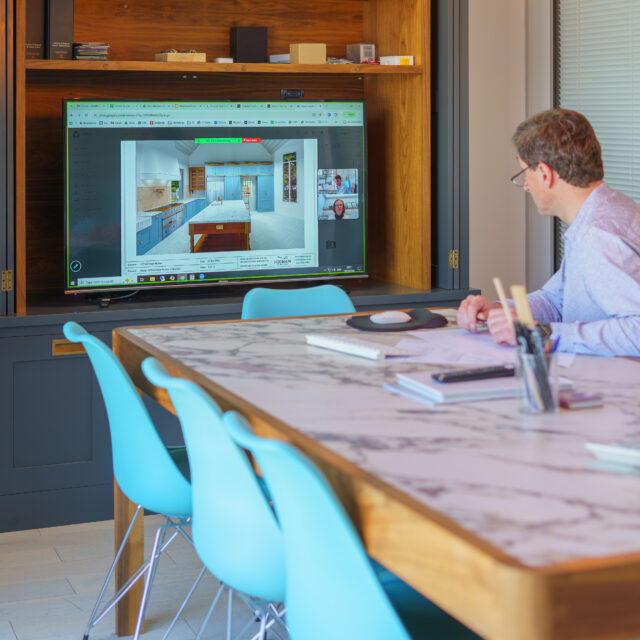
Higham’s 30-minute design call is designed as a low-pressure way to start that conversation. It’s free, it can be done by phone, by video, or in person at the Fulham studio, and it isn’t a sales call. It’s a chance to ask what things cost, what your space can realistically accommodate, and what a handmade kitchen from Denmead actually involves.
No commitment, no quote pressure, no obligation to continue, just clarity before commitment. If you’d like to discuss your own kitchen plans, get in touch with our team.
If you’re weighing up a showroom quote against a bespoke one and want a second perspective from the people who’d make your kitchen, that’s the conversation to have.
Frequently Asked Questions
Is a bespoke kitchen always more expensive than a high-street showroom kitchen?
Not always, but usually at the premium end. The price difference reflects genuine cabinetmaking, solid materials, and design hours rather than retail overhead. Lower down the market, some showroom brands are cheaper than a true cabinetmaker simply because they are selling a modular product with bespoke fronts, not a fully handmade kitchen.
What’s the biggest hidden cost in a high-street showroom kitchen?
Retail overhead: showroom rent, display-kitchen replacement cycles, and sales commission. These can account for a substantial share of the final price, and they don’t improve what’s installed in your home.
Does Higham Furniture have a showroom I can visit?
Higham runs a design studio in Fulham, London for client consultations, and clients can also visit the workshop in Denmead, Hampshire to see kitchens being built. The no-showroom model is deliberate: it means your money funds the kitchen itself rather than a retail estate.
Why is Higham sometimes more expensive than other bespoke-style kitchen brands?
Because the design complexity, cabinetmaking detail, and materials are of a higher standard. Genuine in-frame construction, solid timber frames, oak-veneered plywood carcasses, and workshop-applied paint finishes all cost more than modular alternatives with a bespoke-looking finish.
How do I tell whether a kitchen quote reflects real cabinetmaking or retail mark-up?
Ask about the carcass material, where the paint is applied, whether the frames are structural, whether you can visit the workshop, and who installs the kitchen. A direct-from-maker cabinetmaker answers these questions immediately. A reseller often can’t.
What happens in a 30-minute design call with Higham?
It’s a no-obligation conversation about your space, your timeline, your budget, and what a handmade kitchen from Higham would involve. It can be by phone, video, or in person at the Fulham studio. It’s positioned as clarity before commitment, a better first step than a showroom visit.