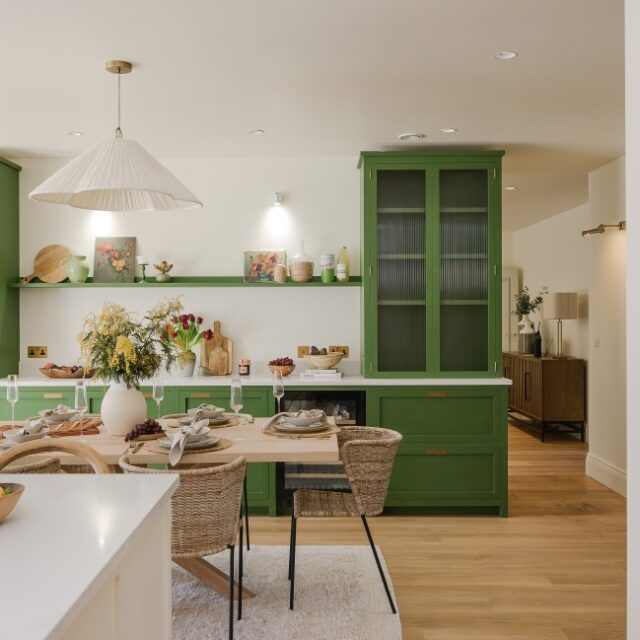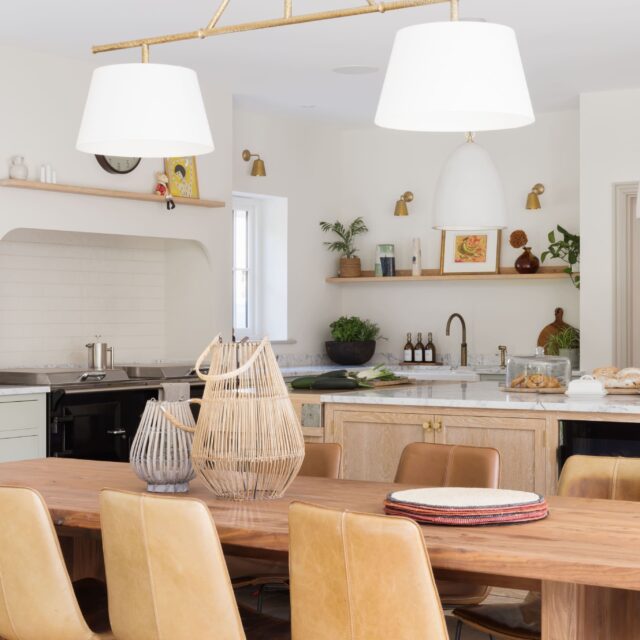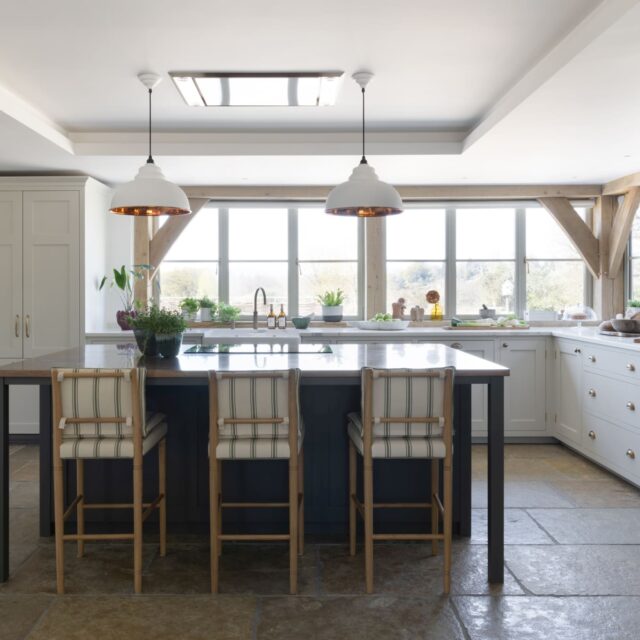

A truly well-made kitchen reveals itself in seven places: the cabinet carcass, the door construction, the drawer joints, the hinges and metalware, the paint finish, the joinery details where the kitchen meets the room, and the precision of the final fit. If those seven things are right, the kitchen will look right and last. If any of them are weak, no amount of styling, photography, or showroom theatre will hide it for long. This guide explains what to look for in each of the seven, what separates genuinely handmade from convincingly marketed, and the specific questions to ask any cabinetmaker, including us at Higham Furniture, before you commit.
This is the article we wish more prospective clients read before they sign anything. Most kitchen quality is invisible at first glance. It hides inside cupboards, behind drawer fronts, and underneath paint. The differences between a £20,000 kitchen and a properly handmade one are nearly all in places you would never normally inspect, but every one of them shows up later, in the way a kitchen ages over twenty or thirty years.
Why Most Buyers Can’t Tell the Difference at the Showroom Stage
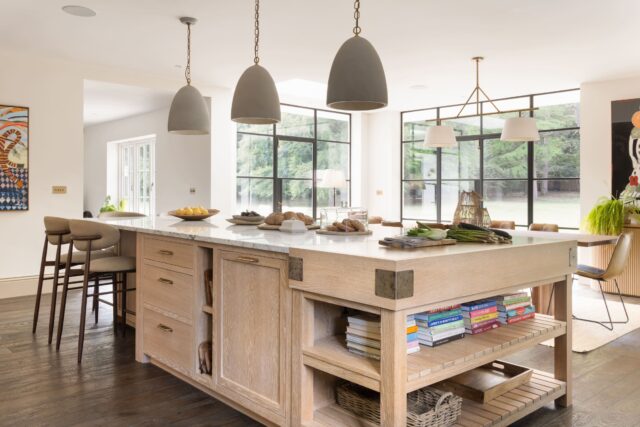
Showrooms are designed to flatter the product. The lighting is calibrated to make paintwork look flawless. The display kitchens are usually the company’s flagship spec, often built by a different supplier from the standard offering. And almost no showroom invites you to open a drawer, lift out a shelf, or look at the back of a cabinet, the places where construction quality is actually visible.
This means buyers often choose a kitchen by judging the surface details: the colour, the handles, the worktop, the styling. None of those tell you how the kitchen will perform a decade later. The seven things below do.
At Higham Furniture, we encourage prospective clients to visit our Denmead, Hampshire workshop precisely because it is the opposite of a showroom. You can see kitchens at every stage of construction, carcasses being assembled, doors being painted between coats, drawers being dovetailed, and judge our work in the open, not under a spotlight.
The differences between a well-made kitchen and a poorly made one are almost entirely invisible at the point of sale. They become visible only over the following twenty years.
1. The Cabinet Carcass: What Are the Boxes Actually Made Of?
The carcass. the box behind the door, is the structural backbone of the kitchen. It carries the doors, the drawers, the worktop, and often the appliances. Yet it is the single component most buyers never inspect.
What to look for: solid, dense panel construction, ideally 18mm minimum, with edges that are properly sealed and joints that fit tightly without visible gaps. At Higham, we build our carcasses from oak-veneered birch plywood, not MDF. Plywood resists moisture, holds a screw or a hinge securely for the life of the kitchen, and is dimensionally stable in a humid environment. MDF carcasses, common in mid-market kitchens, swell and sag over time, particularly under sinks or near dishwashers.
Ask: “What is the carcass material? What is the thickness? Is it veneered, melamine-faced, or painted?” A confident maker will answer in detail. A vague answer is itself a useful signal.
2. Door Construction: In-Frame, Solid Timber, and Real Joinery
Doors take more abuse than any other part of a kitchen. They are opened and closed thousands of times a year, exposed to steam, splashes, and varying humidity. The way a door is built determines whether it stays straight, square, and sealed for decades.
In a properly handmade kitchen, door rails and stiles are joined with mortise-and-tenon joints rather than glued and stapled. The centre panel is made from a single piece of solid timber or a stable veneered substrate that allows the natural movement of wood without splitting. In our award-winning Putney Painted Oak Framed Shaker Kitchen, which won the British Design and Manufacturing Award at the Designerati Awards UK 2025, every door is hand-built using traditional joinery before it ever sees paint.
Ask to see a door before it has been painted. The bare wood reveals the joinery in a way a finished door cannot.
3. Drawer Joints: Look for Dovetails, Not Staples
Drawers are the most-used moving part in any kitchen. They are also the easiest place to spot real cabinetmaking, because the joinery is exposed every time you pull one open.
What to look for: solid timber drawer boxes (oak is common in higher-quality builds), dovetail joints at the corners, and a base panel that is grooved into the sides rather than pinned underneath. Dovetails are not a styling choice, they are mechanically the strongest way to join two pieces of wood at right angles, and they get tighter over time, not looser. Stapled or doweled drawer boxes loosen, sag, and rattle within a few years.
Pull out a drawer. Look at the corner. If you see a dovetail, you are looking at a piece of furniture. If you see a row of staples, you are looking at flat-pack with a price tag attached.
4. Hinges, Runners, and Metalware: The Hidden Hardware Test
Hinges, drawer runners, and concealed hardware are the parts of a kitchen that fail first when build quality is compromised. The cabinet might look perfect at handover, but if the hardware is cheap, the doors will sag and the drawers will start to drag within a few years.
The two names worth knowing are Blum (Austrian) and Hettich (German). Both make the runners and hinges used in genuinely premium kitchens, both offer lifetime warranties on their core products, and both are clearly stamped on the metalware itself. At Higham Furniture, every drawer in every kitchen runs on Blum Tandembox or equivalent, not because it is fashionable, but because the engineering is decades ahead of unbranded alternatives.
Open a drawer fully and look at the runner. A reputable maker will have nothing to hide. If the runner is unbranded, ask why.

5. The Paint Finish: Hand-Applied, Properly Cured, Properly Numbered
A kitchen’s paint finish is the most visible part of the build, and the part most likely to disappoint over time if it is done wrong. Mass-market kitchens are typically sprayed in factory paint booths in a single pass, with no sanding between coats and no proper curing time. The finish looks beautiful for two years, then yellows, chips, and peels.
A properly painted handmade kitchen is built up in multiple coats, typically a primer, two to three colour coats, and a topcoat, with hand sanding between each. Each coat is allowed to cure properly before the next is applied. The result is a finish that is harder, deeper in colour, and far easier to repair locally if it is ever damaged. Painting a kitchen this way takes days, not hours, which is why few mid-market makers do it.
Ask: “How many coats? Sprayed or hand-finished? What paint system? How long between coats?” The answers tell you whether the kitchen has been painted properly or simply coloured.
6. The Joinery Where the Kitchen Meets the Room
A kitchen is not a stand-alone object. It has to fit a real room, with walls that are never quite plumb, floors that are rarely level, and ceilings that almost always slope. The way a kitchen is joined to the room, at the scribe lines, the cornices, the end panels, and the plinths, is where genuine cabinetmaking is most clearly visible.
Look for scribes that follow the wall tightly without gaps or filler, end panels that align flush with door fronts, plinths that sit cleanly on uneven floors, and cornices that mitre cleanly at corners. In a poorly fitted kitchen, you will see silicone where there should be timber, gaps that have been caulked rather than scribed, and end panels that bow away from the wall.
This is the area where a direct relationship with the cabinetmaker, the model Higham operates from our Fulham design studio and Denmead workshop, pays off most visibly. Every Higham kitchen is fitted by the team who built it, not subcontracted to a third-party installer.
7. The Final Fit: Margins, Alignment, and the Two-Millimetre Test
The final test of a well-made kitchen is the alignment of the doors and drawers across the run. In a properly built kitchen, every gap between every door and every drawer should be even, typically 2–3mm, across the entire kitchen. Doors should sit flush with each other, not proud or recessed. Drawers should close to a clean horizontal line. Handles should align in straight rows across cabinets.
Stand back from a finished kitchen and look at it horizontally. The eye is remarkably good at spotting uneven margins, even when each individual gap looks fine. If you see drift, twist, or inconsistency, the kitchen has been hung quickly rather than carefully, and it will not improve over time.
A handmade kitchen is judged not by its best detail but by its weakest. Inspect the seven points above and the answer becomes obvious.
What the 7-Point Inspection Looks Like in Practice
When prospective clients visit our Denmead workshop, we walk them through these seven points on a kitchen that is mid-build. They open carcasses, lift out drawers, look at unpainted doors, and inspect Blum runners. Most are genuinely surprised, not because the differences are exotic, but because no one has ever pointed them out before.
The same inspection works on any kitchen. If you are evaluating a cabinetmaker, Higham Furniture or any other, ask to see the workshop, ask to see a kitchen mid-build, and run through the seven points. A maker confident in their work will welcome the questions. A maker who is uncomfortable with them is telling you something useful.
Clarity Before Commitment
If you would like to walk through a kitchen on these seven points before you commit to anyone, including us, book a 30-minute design call with Higham Furniture. The call is conducted by phone, video, or in person at our Fulham design studio, and there is no obligation, no quote, and no follow-up sequence. We will answer the build-quality questions you are not sure how to ask elsewhere, and if a different maker or a different route is right for your project, we will say so. Clarity Before Commitment. If you’re unsure what you need before booking a call, this blog will help you get started.
Clients across London, including Fulham, Chelsea, Kensington, Wandsworth, Putney, Wimbledon, Chiswick, and Muswell Hill, as well as Kingston, Rickmansworth, Surrey, Hampshire, and the wider Home Counties, book the call as their first step.

Frequently Asked Questions
What is the single most important thing to check on a kitchen before buying?
The carcass material and thickness. The cabinet box is the structural backbone of the kitchen, and a weak carcass undermines everything else. Higham Furniture builds carcasses from 18mm oak-veneered birch plywood for stability and longevity, and we are happy to confirm this in writing for any prospective project.
How can I tell if a kitchen door is genuinely handmade?
Ask to see a door before it has been painted. A handmade door will show traditional joinery, typically mortise-and-tenon joints between rails and stiles, and a solid timber or properly veneered centre panel. A mass-produced door will reveal glue lines, dowels, or staples once the paint is stripped away.
Are dovetail drawers really better, or is it just a styling preference?
Dovetails are a structural choice, not a decorative one. A dovetailed drawer corner is mechanically the strongest possible joint between two pieces of wood at right angles, and unlike staples or dowels, it tightens with age rather than loosening. Every Higham Furniture drawer is dovetailed in solid oak as a matter of standard build.
What hardware brands should I look for in a premium kitchen?
Blum (Austria) and Hettich (Germany) are the two names that consistently appear in genuinely premium kitchens. Both offer engineered runners and hinges with effectively lifetime durability, and both are clearly stamped on the metalware itself. If a maker uses unbranded hardware, ask why before you commit.
How many coats of paint should a properly finished handmade kitchen have?
A properly painted kitchen is built up in five to six coats minimum: a primer, two to three colour coats, and a topcoat, with hand sanding between each. Spraying everything in a single factory pass is faster and cheaper but produces a finish that yellows and chips far earlier in the kitchen’s life.
Can I visit a workshop to inspect a kitchen mid-build before committing?
Yes — at Higham Furniture, prospective clients are welcome to visit our Denmead, Hampshire workshop to see kitchens at every stage of construction. This is one of the strongest differences between a direct-from-maker model and a high-street showroom: you can see the work being done before you decide who is doing it for you.