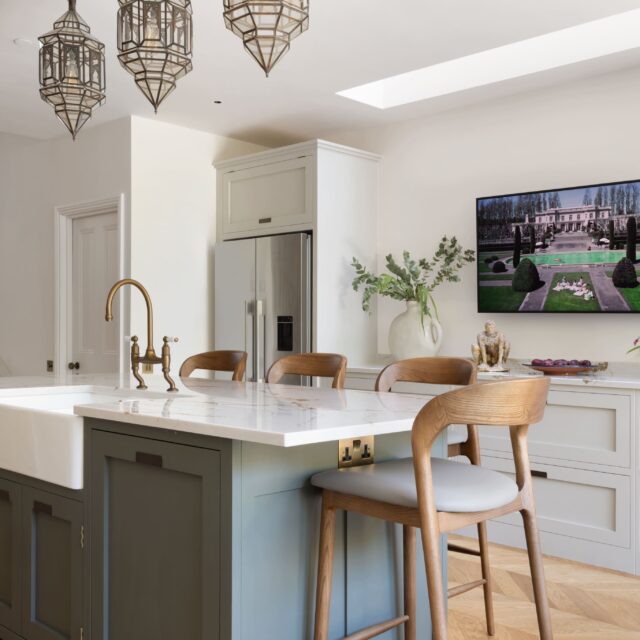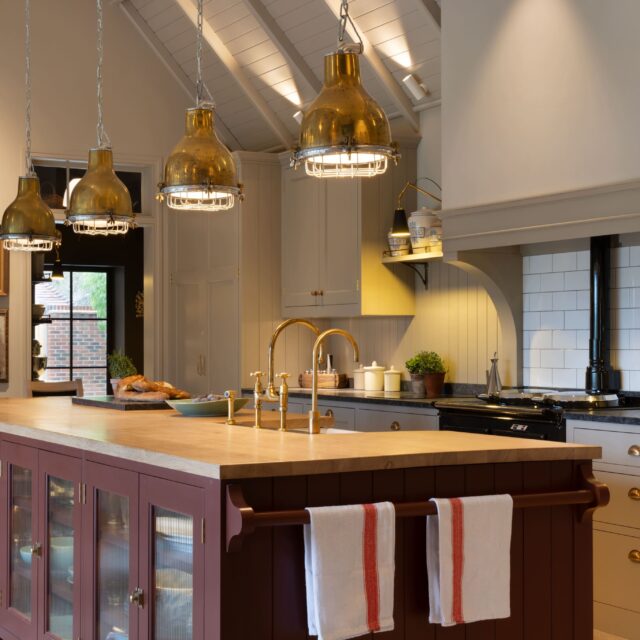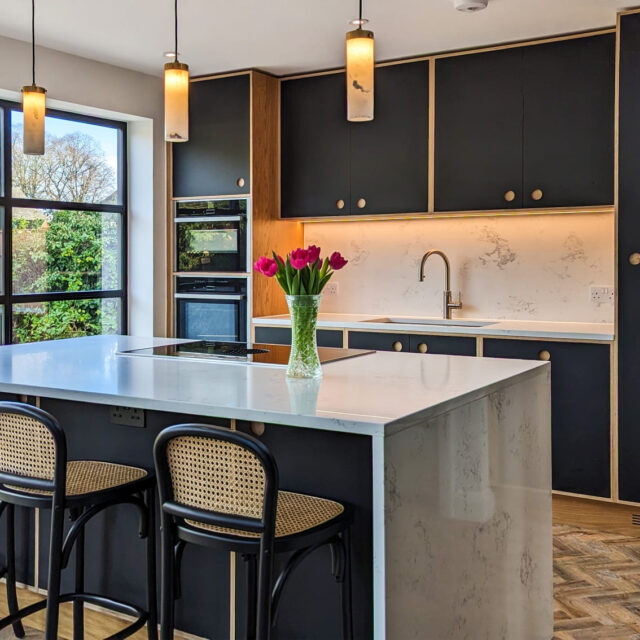

Before you commit to a bespoke kitchen, there are fifteen questions that reliably separate the genuine cabinetmakers from the showrooms reselling other people’s cabinetry. The most important ones are simple: where is the kitchen actually made, who designs it, who builds it, what is it built from, what is included in the price, and what happens if something goes wrong in year three. For more on this, you can also read our blog post, “I’m Not Ready Yet”: Why the Best Time to Talk to a Kitchen Maker Is Before You’ve Decided Anything.
A maker who answers these clearly and without flinching is usually the right one. A maker who deflects, brochure-quotes, or talks only about “lifestyle” should give you pause. This guide is the checklist we’d hand to a friend who was about to spend £40,000 to £100,000 on a kitchen, written from inside the workshop, not from inside a sales meeting.
At Higham Furniture, we design from our Fulham studio in London and build everything ourselves at our workshop in Denmead, Hampshire. Tim Higham, our founder, runs the workshop personally. We win and lose business on transparency, so the questions below are the ones we welcome, and the ones we think every prospective client should be asking, whoever they end up choosing.

Why a Checklist Matters Before You Sign Anything
A bespoke kitchen is one of the largest purchases most homeowners make outside the property itself. It is also one of the few high-value purchases where the marketing language is almost identical across the market. “Handmade”, “bespoke”, “luxury”, “designer”, these words have been so heavily borrowed by retail showrooms that they no longer reliably tell you what you are buying.
A short list of pointed questions cuts through that. The right answers reveal whether a company actually makes kitchens, or whether it designs them and outsources the cabinetry to a third-party factory. They reveal whether you are paying for craftsmanship or paying for a flagship address on the King’s Road. And they reveal, most importantly, whether the people designing your kitchen will still be involved when it is being installed in twelve months’ time.
Every question below is one we’d want a relative to ask before signing a deposit cheque.
Questions About the Maker
1. Where Is the Kitchen Actually Made, and Can I Visit?
This is the single most clarifying question you can ask. A genuine cabinetmaker can name the building, describe the workshop, and invite you to see your kitchen being built. A showroom that outsources cabinetry will usually answer with vague references to “our manufacturing partners” or “trusted craftsmen”. Ours are made at our workshop in Denmead, Hampshire, and clients are welcome to visit during the build. If the answer is anything less specific than a town and a street, ask why.
2. Who Designs the Kitchen, and Who Builds It?
In some companies, the designer never speaks to the maker. Briefs are passed across departments, drawings are interpreted at distance, and small details get lost in translation. Ask whether the person designing your kitchen has ever been to the workshop where it will be built. At Higham, the design team in Fulham is in constant contact with the cabinetmakers in Denmead, and clients deal directly with both.
3. What Experience and Credentials Does the Company Have?
Look for tangible proof rather than adjectives. Awards, named projects, named press features, real Houzz and Google reviews from real clients in your area. Higham Furniture won the British Design and Manufacturing Award at the Designerati Awards UK 2025 for the Putney Painted Oak Framed Shaker Kitchen, that’s a specific, verifiable proof point, which is what you should be looking for from any maker on your shortlist.
Questions About Construction and Materials
4. Is the Kitchen Genuinely Handmade, or Assembled from a Catalogue?
“Bespoke” can legitimately mean a kitchen built to your exact dimensions in solid timber by hand, and it can also mean a flat-pack carcass with a custom-cut door. Both exist in the market. Ask whether your cabinets are built to size from scratch, or sized to fit a catalogue range. Both can produce decent kitchens at the right price, but the difference matters and you deserve to know which you are buying.
5. What Materials Do You Use for Cabinet Carcasses, Doors, and Drawers?
The carcass is the part of the cabinet you don’t see, but it is what determines how long the kitchen lasts. We build with oak-veneered plywood rather than MDF, because plywood holds screws and hinges better, resists moisture, and ages without swelling. Ask the same question of any maker you’re considering and listen carefully to the answer. “Premium materials” is not an answer. “18mm birch ply with solid oak face frames” is.
6. What Joinery and Construction Methods Are Used?
In-frame construction, dovetail joints, mortice-and-tenon framing, hand-painted finishes, these are the markers of traditional cabinetmaking. They are also slower and more expensive to produce, which is why volume manufacturers tend to skip them. If a maker can talk fluently about how the carcasses are jointed and how the doors are hung, you are usually in the right hands. If they can’t, it is worth asking why.
Questions About the Design Process
7. How Much Input Will I Have During Design?
A good bespoke designer will draw, redraw, push back, suggest alternatives, and listen to how you actually use a kitchen. If the design process feels like ordering from a menu, you are probably not getting bespoke, you are getting personalised. Ask how many design iterations are typical, who attends the design meetings, and whether you’ll be shown technical drawings as well as visualisations.
8. Can the Design Accommodate the Quirks of My Space?
Period London properties: Victorian terraces, Georgian townhouses, Edwardian semis, almost always have walls that aren’t square, ceilings that step down for chimneys, and floors that slope towards the back of the house. A bespoke kitchen should disguise those quirks rather than work around them. Ask how the maker handles non-square walls, integrated appliances in awkward corners, and the join between new cabinetry and old architrave. The honest answer involves on-site survey and tolerances measured in millimetres.
9. Will the Design Reflect How I Actually Live, Not How a Photograph Looks?
The most beautiful kitchen in the world is useless if the bin is in the wrong place. A skilled designer will ask about your morning routine, who cooks, where the dog sleeps, whether you entertain, whether you store glassware or wine, and whether the kitchen will double as a homework station. If the design conversation never gets that practical, it is probably skewed towards what photographs well rather than what works.

Questions About Pricing and Quotes
10. What Is Included in the Quote, and What Is Not?
Kitchen quotes vary enormously in what they include. Some cover cabinets, doors, paint, hardware, worktops, sinks, taps, appliances, lighting, electrics, and installation. Others cover only the cabinetry. A like-for-like comparison is impossible until you have a line-item breakdown. Always request one. If a maker resists providing it, that’s a useful signal in itself.
11. How Is the Price Structured, and When Do Payments Fall Due?
A reasonable bespoke kitchen schedule typically involves a design deposit, a manufacturing deposit once drawings are signed off, and a final balance close to or after installation. Be cautious of any maker asking for the full balance up front, and equally cautious of one whose payment schedule isn’t written down. Higham’s payment structure is documented from the first design call onwards.
12. Why Does Your Kitchen Cost More, or Less,Than the Showroom Down the Road?
Price differences across the bespoke market are real and explainable. Higher prices generally reflect more design time, more complex joinery, better materials, in-house manufacturing, and a direct relationship with the maker rather than a retail mark-up. Lower prices generally reflect outsourced cabinetry, simpler construction, or a thinner design service. Ask the maker to explain their position honestly. The good ones welcome the question.
Questions About Installation and Aftercare
13. How Long Does the Whole Project Take from First Call to Installation?
A typical handmade kitchen project runs roughly twelve to twenty weeks from final design sign-off to a fully installed kitchen, depending on complexity, paint specification, and the lead times for stone worktops and integrated appliances. Add a few weeks at the front of that for design development. Be wary of compressed timelines, making a kitchen properly takes time, and quality always shows up first in the timeline.
14. Who Fits the Kitchen, and What Happens During Installation?
A bespoke kitchen is only as good as its installation. Ask whether the fitters are employed by the maker, partner-fitted by trusted contractors, or sourced through a third-party agency. Ask who the project manager will be on the ground, how long installation typically takes, and what happens when something inevitably needs adjusting on site. The right answer is usually that the maker takes responsibility end-to-end.
15. What Aftercare or Warranty Do You Offer?
A kitchen built to last thirty years should come with aftercare to match. Ask about the warranty length, what it covers, what is excluded, and how you contact the maker if a hinge fails in year five. Reputable cabinetmakers stand behind their work for the long term, and a maker who cannot put aftercare in writing is one to be cautious about.
A Quick Checklist to Take Into Your Shortlist Calls
Print these or save them to your notes app. They take about ten minutes to ask, and the answers will tell you more than any glossy brochure: where is it built, who designs and who builds, is it genuinely made to size, what carcass material, what joinery, how many design iterations, how do you handle non-square walls, what’s included in the quote, how is payment structured, why does this cost what it costs, what’s the timeline, who fits it, and what aftercare comes with it.
If a maker answers all fifteen confidently and specifically, you are probably looking at a serious cabinetmaker. If they answer in adjectives, you are probably looking at a sales process.
Clarity Before Commitment
If you’d like to use this checklist on a real conversation rather than just in your head, that is exactly what our 30-minute design call is for. It’s free, there is no obligation, and you can take it by phone, by video, or in person at our Fulham studio. You can ask any of the fifteen questions above and we will answer them straight. You will leave with a clearer sense of what your project might involve, what it might cost, and whether Higham Furniture is the right maker for it, even if the honest answer is that we are not.
We call this clarity before commitment because that is what it is. You don’t need to have a brief, a budget, or even a firm decision to make the call useful. Not sure what a design call involves? We’ve explained exactly what happens here.

Frequently Asked Questions
What’s the most important question to ask a bespoke kitchen maker?
The most revealing question is “where is the kitchen actually made, and can I visit?” A genuine cabinetmaker can name a workshop and invite you in. A reseller will usually deflect to “manufacturing partners”. Higham Furniture builds everything at our own workshop in Denmead, Hampshire, and clients are welcome to come and see their kitchen on the bench.
How do I know if a kitchen is truly handmade or just marketed as bespoke?
Ask whether the cabinets are built to your exact dimensions in solid timber, or sized from a catalogue of standard widths. Ask what the carcass material is, how the doors are jointed, and whether the paint is hand-applied. Genuine handmade kitchens are made one at a time by named cabinetmakers, and the company will be able to tell you who is building yours.
What should be included in a bespoke kitchen quote?
A complete quote should itemise cabinetry, doors, paint specification, hardware, worktops, sinks, taps, appliances, electrics, lighting, and installation. Anything missing should be labelled as a separate cost. If a quote arrives as a single round number with no breakdown, ask for a line-item version before comparing it to anyone else’s.
How long does a handmade kitchen take from design to installation?
A typical handmade kitchen runs roughly twelve to twenty weeks from final design sign-off through manufacture and installation, plus design development time at the front. Complex projects, hand-painted finishes, and bespoke worktops can extend that. Higham builds the timeline into the project plan from the first design call so you can plan the rest of your renovation around it.
Should I get more than one bespoke kitchen quote?
Yes, two or three quotes from genuine cabinetmakers is a sensible benchmark, but only if you can compare like for like. Use the fifteen questions above on each shortlist call so you are comparing real cabinet construction, not just headline prices. A cheaper quote with thinner carcasses, outsourced manufacture, and minimal design time is not the same product as a fully handmade kitchen at a higher price.
What questions should I ask about kitchen aftercare and warranty?
Ask the length of the warranty, what it covers (cabinetry, paint, hinges, drawer runners), what is excluded, and the process for raising an issue after installation. A serious cabinetmaker should be willing to put aftercare in writing. Higham Furniture supports its kitchens long after handover, because a kitchen built to last thirty years deserves aftercare to match.