
The best time to speak to a handmade kitchen maker is not when you have a finished brief, a measured drawing, a shortlist of finishes, and a signed-off budget. It is earlier than that, when you are still forming a view of what the room could be, what you actually want, and what a kitchen at this level involves.
A good cabinetmaker is most useful before any of those decisions are fixed, because the conversation is where many of them are properly made. At Higham Furniture, that conversation is deliberately structured as a free 30-minute design call; no obligation, no quote pressure, no sales script, precisely because so many of the clients who eventually commission a kitchen tell us afterwards they wish they had made the call months earlier than they did.
This article is for anyone who has thought, “I’m not ready to talk to a kitchen company yet.” It explains why that instinct, while understandable, is often working against you, and what an early conversation with a maker like Higham actually looks like.
Why “Not Ready” Usually Means “Not Yet Certain”
When people tell us they are not ready, what they almost always mean is that they are not yet certain. They are not sure about the layout. They are not sure what a realistic budget looks like. They have seen handleless kitchens they like and shaker kitchens they like, and cannot quite articulate which one belongs in their home.
They are worried about being asked a question they cannot answer, or more commonly about being pushed towards a decision before they have had time to think.
That is a reasonable set of concerns. It is also, in our experience, the exact reason to have the conversation, not to delay it.
A handmade kitchen is a considered purchase. It is not something you buy off a showroom floor. It is designed, specified, and built around your home, your habits, and your architecture. The decisions involved layout, construction method, materials, finishes, worktop, appliances, lighting, hardware, interact with one another in ways that are difficult to unpick alone. A good cabinetmaker’s job, at the earliest stage, is not to sell you a kitchen. It is to help you understand what kind of kitchen the project actually is.
What Early Really Means in a Kitchen Project
There is a myth, particularly among first-time commissioners of a handmade kitchen, that you need a complete brief before you make contact. In reality, “early” in a handmade kitchen project can mean almost anything up to the point where you sign off on a final design.
We regularly speak to clients who are:
Still deciding whether to renovate the existing kitchen or knock through into an extension. Still waiting on an architect’s plans, or still deciding whether to appoint an architect at all. Still unsure about whether their budget stretches to a properly handmade kitchen, or whether a showroom alternative would be more sensible. Still a year or two away from the actual project starting, but wanting to understand the landscape before they commit time and money to design drawings.
All of these conversations are useful, to the client and to us. They are not quotes. They are not proposals. They are the quiet, clarifying discussions that turn a half-formed idea about a new kitchen into a project with shape and direction.
What You Don’t Need to Know Before the First Conversation
One of the most common reasons prospective clients delay making contact is that they assume we will expect a detailed brief. We do not.
You do not need a final layout. You do not need measured drawings. You do not need a list of appliances, a paint swatch, or a worktop sample. You do not need to have decided between in-frame and overlay cabinetry, between painted and natural timber, or between a shaker door and a handleless one. You do not need a fixed budget; a rough bracket is enough, and if you are not sure what a realistic bracket is, that itself is a good reason to talk.
What we ask for at the first call is simpler. Some sense of the property, period, area, rough size of the kitchen space. Some sense of what is prompting the project, moving in, extending, replacing an ageing kitchen. Some sense of the timescale, even if it is vague. And any questions, however basic, that have been holding you back from getting started.
Everything else emerges in the conversation.
 What an Early Conversation Actually Gives You
A well-run early conversation with a cabinetmaker should do three things. It should give you a clearer map of the decisions ahead. It should give you a realistic sense of what the work you are contemplating actually involves in time, in cost, and in process. And it should help you decide whether the maker in front of you is the right fit for the project, or whether you would be better served elsewhere.
That last point matters. Not every client who speaks to Higham Furniture is a good fit for Higham Furniture, and we say so when that is the case. An honest early conversation occasionally ends with us recommending a different route, a more modular maker, a showroom brand, an architect-led procurement, because the project does not call for what we do. A maker who cannot do this is not having a conversation; they are running a sales funnel.
Clients who talk to us early tend to arrive at design stage with a much clearer sense of what they want, what they do not want, and what is worth spending on. They make fewer U-turns. They spend less money on revisions. And they tend to be far more confident about the decisions they eventually sign off on.
The Cost of Waiting Until You’re “Ready”
The cost of waiting is rarely obvious at the time. It shows up later, in the form of decisions that would have been easier, cheaper, or better-informed if the right conversation had happened sooner.
Clients who wait too long before speaking to a maker often find they have committed to architectural plans that assume a particular kitchen layout, plans that a cabinetmaker would have gently redrawn at concept stage. They find they have budgeted for a kitchen at a different level than the one they actually want.
They find they have fallen in love with a style they have seen on Instagram that does not quite belong in their period property, and have to talk themselves around to something more appropriate under time pressure.
None of these are catastrophes. But they are preventable. Every one of them is a conversation that should have happened six months earlier than it did.
At our workshop in Denmead, Hampshire, and at our design studio in Fulham, we see the consequences of late conversations weekly. The pattern is consistent: the clients who commission the kitchens they are most pleased with are, almost without exception, the clients who started the conversation before they felt ready.
How the 30-Minute Design Call Works at Higham Furniture
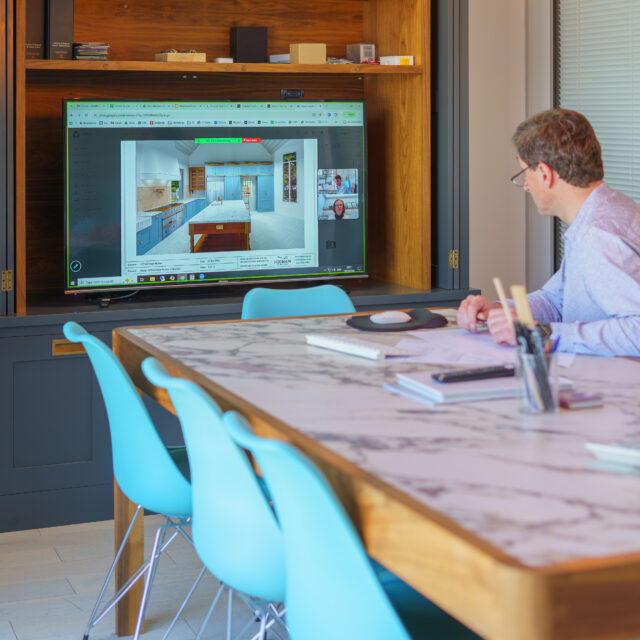
The Higham 30-minute design call is the deliberate answer to the “not ready yet” problem. It is a free, no-obligation conversation, by phone, by video, or in person at our Fulham studio, built specifically to be useful at any stage of a project, including the earliest.
It is structured, not scripted. Tim Higham or one of our senior designers will typically ask you about the property, the project, what has prompted you to start thinking about a new kitchen, and what has been stopping you from moving forward.
We will answer any questions you want to ask, about construction, finishes, materials, worktops, appliances, lead times, cost bandings, the design process, how a cabinetmaker differs from a showroom brand, or anything else on your mind.
There is no obligation at the end of the call. No quote. No follow-up sales sequence. If the conversation is useful and you want to go further, we talk about the next step. If the conversation confirms that Higham is not the right fit, or that the project is not yet ready to progress, we say so, and we part on good terms.
That is what “Clarity Before Commitment” means in practice. It is a commercial decision on our part, not a marketing line. We would rather have a useful 30-minute conversation with someone who takes twelve months to decide than pressure someone into a premature meeting and lose them entirely.
Who the Design Call Is Really For
The design call is not for people who already have a fully resolved brief and three quotes on the table. Those clients are welcome to talk to us, but by then most of the hard decisions are made.
It is for the person who has been looking at kitchen images for eight months and feels no closer to knowing what they want. It is for the homeowner in Chelsea or Kensington who is about to appoint an architect and wants to understand how the kitchen will fit into that process.
It is for the family in Wandsworth or Putney planning a side return extension next year and wondering whether a handmade kitchen is within reach. It is for the buyer in Surrey, Hampshire, or the Home Counties who is early in a barn conversion and has no idea how an in-frame shaker would sit in the space.
In other words, it is for anyone who is genuinely unsure, which, on a project of this size, is almost everyone at the start.
Clarity Before Commitment
If you have been telling yourself “I’m not ready yet,” the honest answer is that you probably are for a conversation, if not yet for a kitchen. A 30-minute design call with Higham Furniture is free, carries no obligation, and is designed specifically for the stage of a project where nothing is decided.
The call can be by phone, by video, or in person at our Fulham studio. You will speak to someone who actually designs and oversees the making of the kitchens, not a salesperson working through a script. Ask anything. Bring nothing. Leave with a clearer map of what the project ahead of you really looks like.
That is a better first step than any showroom visit.
Frequently Asked Questions
When is the best time to contact a handmade kitchen maker?
The best time is as soon as a new kitchen is on your mind, not once you have a finished brief. At Higham Furniture, we encourage clients to make contact while layout, budget, and style are still being explored, because the conversation helps shape those decisions. Early conversations consistently lead to better-resolved projects than late ones.
Do I need to know my budget before a design call?
No. A rough bracket is helpful if you have one, but many clients come to the call precisely because they want to understand what a realistic budget looks like for their project. Part of the call is establishing whether the scale of what you want and the level at which you want it are in the same neighbourhood as what a cabinetmaker like Higham Furniture actually builds.
Will I be pressured to commit on the design call?
No. The Higham 30-minute design call is deliberately structured around “Clarity Before Commitment”, there is no quote at the end, no follow-up sales sequence, and no pressure to book a second meeting. If the conversation confirms we are the right fit, we talk about the next step. If it does not, we part on good terms.
What can I ask in a 30-minute design call?
Anything. Clients typically ask about construction (in-frame versus overlay), materials, finishes, worktops, appliances, lead times, design process, and cost bandings. You can also ask how a handmade kitchen maker like Higham differs from a showroom brand, or how the process works for clients who are still a year or more from starting.
Is the design call available remotely?
Yes. The call can be conducted by phone, by video, or in person at our design studio in Fulham, London. Many of our London and Home Counties clients start with a video call before visiting either the Fulham studio or our workshop in Denmead, Hampshire.
How long before a project starts should I make contact?
There is no “too early.” We regularly speak to clients who are twelve to eighteen months away from their kitchen actually being installed, and those conversations are often the most productive, because there is time to think, to refine the brief, and to integrate the kitchen properly with architectural plans and the wider renovation.