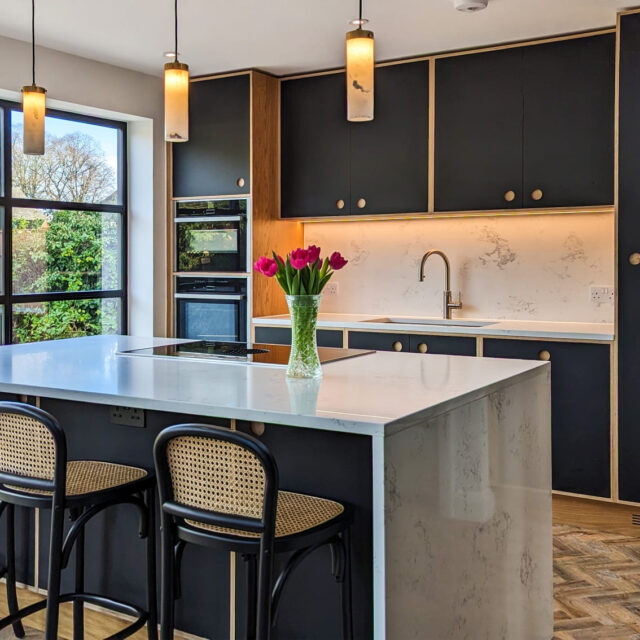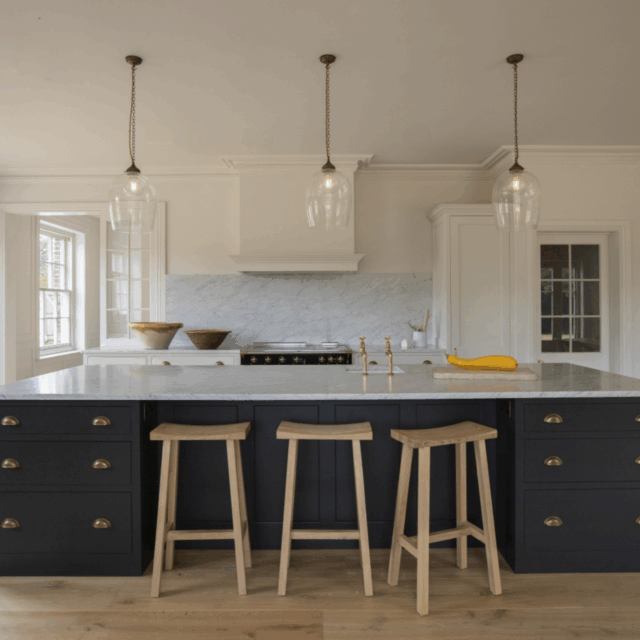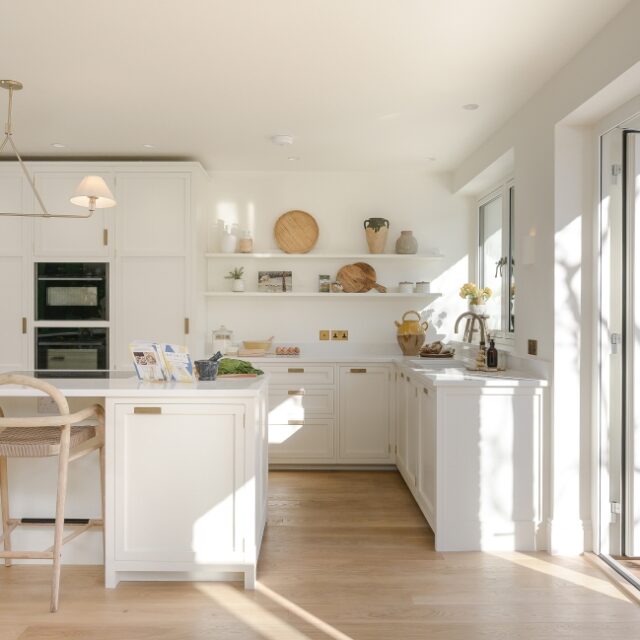
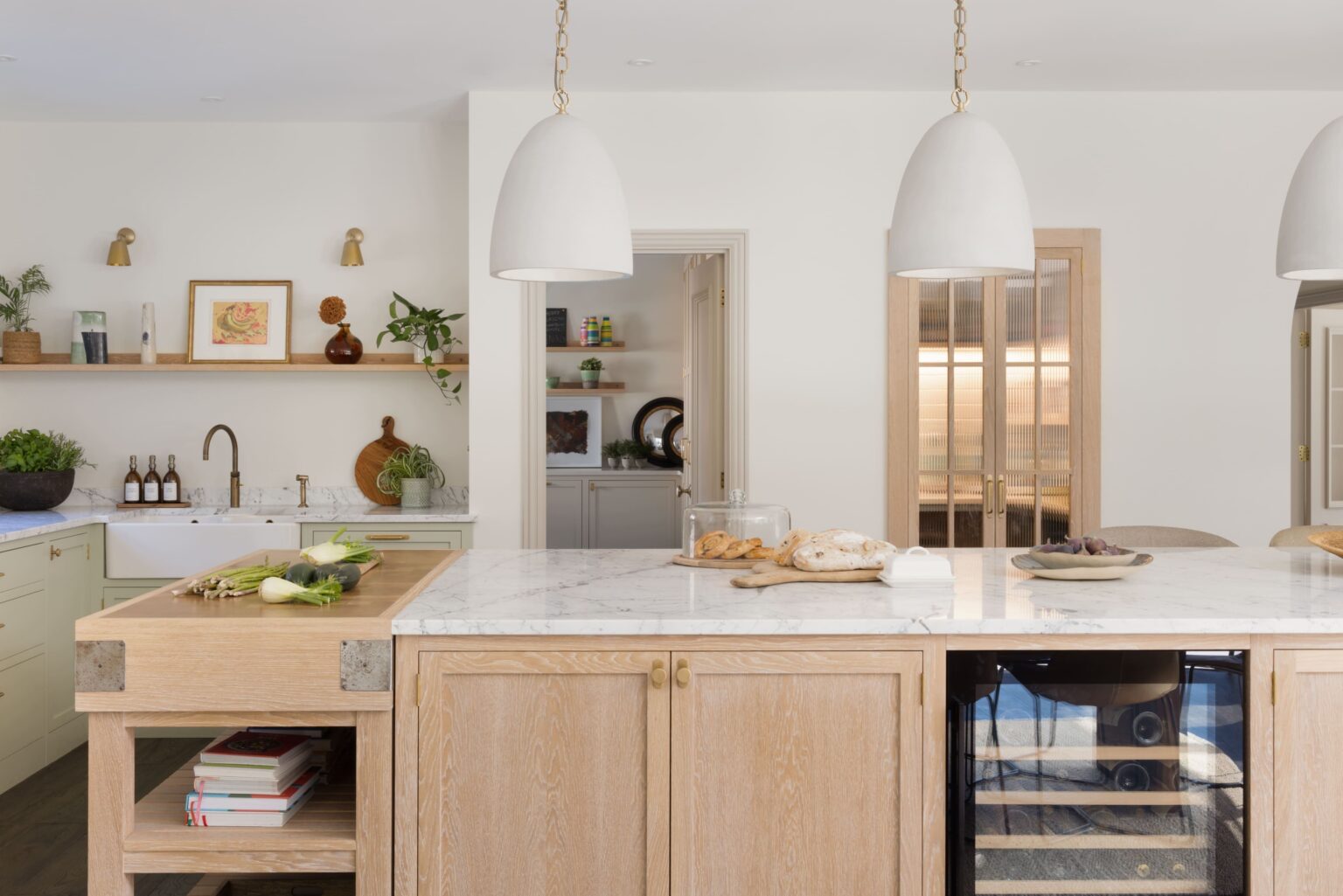
The hidden cost of a cheap kitchen is the one you pay later, in early replacements, failed hardware, peeling finishes, swollen carcasses, and a second full renovation a decade earlier than you should have needed one. A well-made handmade kitchen is designed to last 20 to 30 years. A cheap kitchen is often priced on the assumption it will be replaced in 8 to 12. Once you understand that difference in expected lifespan, the real cost comparison changes completely, and the kitchen that looked expensive at the outset frequently turns out to be the cheaper long-term choice.
At Higham Furniture, we design from our studio in Fulham, London and build every kitchen by hand at our workshop in Denmead, Hampshire. The clients who choose us are rarely comparing on headline price alone. They are making a quieter, more considered calculation about how long a kitchen should last, what it should feel like to live with, and what the real cost looks like over the decades a family actually uses a room. This article sets out the costs most kitchen brochures will not mention, and explains why Higham kitchens are built to the opposite standard. For more information, please get in touch with our team and we will be happy to help.
The Replacement Cycle No One Advertises
The first hidden cost is the one you only discover after five to ten years of ownership: that a cheap kitchen is fundamentally engineered around a short replacement cycle.
Volume kitchen manufacturers work to price points dictated by high-street retail. To hit those price points, corners are cut in places the buyer rarely inspects, carcass material, hinge quality, drawer runner cycles, paint specification, internal fittings. The kitchen looks good in the showroom, photographs well on day one, and performs acceptably for the first few years. Then the wear begins to show, and it shows in places that are expensive or impossible to repair.
Soft-close hinges start to fail. Drawer runners jam. MDF carcasses swell where they meet water. Foil-wrapped doors start to lift at the edges. Painted finishes chip down to bare substrate and cannot be touched up because the colour was never properly matched. Worktop joints open. And because the kitchen was built as a bonded system, not as repairable cabinetmaking, piecemeal repair is rarely possible, the only real fix is replacement.
A handmade kitchen is built to a completely different standard. The components are specified for decades of use, not years. They can be repaired, refinished, and adjusted rather than thrown away. The expected lifespan is not 8 to 12 years but 20 to 30, and often longer.
What Longevity Actually Costs You and Saves You
Consider two kitchens installed in the same year: one from a volume retailer, one handmade by a premium cabinetmaker. On installation day, the handmade kitchen costs noticeably more. Ten years later, the volume kitchen is showing significant wear and is realistically due for replacement within another few years. The handmade kitchen is still operating as designed and has another fifteen to twenty years of life left in it.
Now run the numbers across 25 years. The volume kitchen has been paid for twice, sometimes three times. Each replacement carries not just the cost of the new kitchen itself, but disposal of the old one, weeks of domestic disruption, builders’ work, replastering, flooring repairs where the old units sat, and often appliance replacement at the same time. The handmade kitchen has been paid for once, has required only routine maintenance, and is still in daily use.
This is the calculation most people never make, because kitchen marketing rarely invites it. But it is the calculation that discerning buyers eventually arrive at, usually after living through one replacement cycle of a cheaper kitchen and deciding they will not do it again. If you’re at that point and want a clearer understanding of what a long-lasting kitchen really involves, speak to our team for honest, straightforward advice tailored to your home.
The Cost of Not Liking Your Kitchen
The second hidden cost is harder to quantify but is often the one clients talk about most after the fact: the quiet daily tax of living with a kitchen that does not quite work.
A kitchen is not a decorative object. It is the room where a family spends more waking hours together than any other. Over 20 years, that is tens of thousands of meals, hundreds of thousands of small interactions with drawers, cupboards, surfaces, and storage. Every design compromise made to hit a showroom price point is paid for again every single day you use the kitchen.
Standard-sized cabinets in a non-standard space leave awkward filler panels where there should be usable storage. Off-the-shelf corner solutions waste the very space that a bespoke cabinetmaker would have turned into a pantry. Drawers sized for someone else’s crockery. A worktop layout that forces you to walk around the island every time you move from sink to hob. None of these are visible in photographs. All of them wear on you.
A handmade kitchen designed for your specific space, your ceiling heights, your walls, your appliances, your cooking habits, your family’s daily rhythm, eliminates these frictions. This is not a luxury. It is the ordinary baseline of a kitchen built by a cabinetmaker rather than pulled from a catalogue.
Why Materials Decide Everything That Comes Later
The biggest single driver of longevity is the material specification of the carcasses, doors, and finishes, and it is also the area where the largest quiet savings are made by budget manufacturers.
Cheap kitchens are overwhelmingly built from MDF: medium-density fibreboard, a compressed board that machines cleanly and accepts foil wrapping or spray paint easily. It is cost-effective and, when dry, perfectly serviceable. The problem is water. In a room where water is present every day, MDF eventually swells at any compromised edge, around sinks, at floor level, behind dishwashers. Once swollen, it cannot be dried back. The unit is finished.
Higham Furniture builds every carcass from oak-veneered plywood. Plywood is dimensionally stable, resistant to moisture, and holds fixings securely for decades. The cost difference on the cabinetry alone is significant, but so is the difference in useful life. A plywood carcass kitchen is still structurally sound in year 25. An MDF kitchen frequently is not.
The same logic applies to door construction, paint specification, hardware choice, and joinery method. At every layer, the cheap kitchen borrows from its future to reduce its present price. The handmade kitchen spends at the outset to eliminate that future cost.
The Craftsmanship That Does Not Photograph
There is a class of quality markers in a handmade kitchen that never shows up in a photograph, but that entirely determines how the kitchen feels to use over decades.
Dovetail joints in drawer boxes. Solid timber drawer bases rather than stapled hardboard. Properly scribed back panels that follow the wall rather than sit awkwardly away from it. Hand-fitted in-frame doors with consistent gaps measured in fractions of a millimetre. Cornices cut and joined on site rather than butted together from stock lengths. Pilasters that are part of the cabinetry structure, not glued on afterwards.
None of these details appear in a showroom price comparison. All of them are the difference between a kitchen that is still operating beautifully in year 30 and one that is already showing its weaknesses in year 5.
Higham’s award-winning Putney Painted Oak Framed Shaker Kitchen, the project that won the British Design and Manufacturing Award at the Designerati Awards UK 2025, is a clear demonstration of this level of detail. It was recognised not for a visual style but for the quality of the cabinetmaking underneath it. That quality is what buys you decades of life.
The Environmental Case for Not Throwing Kitchens Away
The most overlooked cost of a cheap kitchen is the one that does not appear on any invoice: the environmental cost of a room that is built to be thrown away.
Replacing a kitchen every decade means three kitchens’ worth of materials sent to landfill in the same period that a properly made kitchen would still be in service. It means three rounds of manufacturing energy, three rounds of transport emissions, three rounds of waste. For clients who care about the environmental footprint of their home, a well-made handmade kitchen is, in real terms, the greener choice, not because of what it is made of, but because of how rarely it needs to be replaced.
This is the quiet mathematics behind the statement that a 30-year kitchen is the greenest kitchen a household can choose. It is also why, in many of our project conversations, clients who began by asking about sustainability end up asking about construction standards and material specifications. The two questions turn out to be the same question.
Why Direct-from-Maker Matters to Longevity
The final hidden cost of a cheap kitchen is one that only becomes visible when something needs fixing: the absence of a direct relationship with the people who actually made the kitchen.
When a showroom brand sells a kitchen, the design, manufacture, and installation are usually handled by different businesses, each passing the specification down the chain. If something needs adjusting in year three, or a door needs refinishing in year seven, the original maker may no longer be reachable. The specification may not be retrievable. The paint code may not be recorded. The hardware may no longer be stocked.
At Higham Furniture, the design studio, the workshop, and the installation team are the same business. Every kitchen we have made is documented. Every component is specified and logged. A client who wants a door touched up, a drawer adjusted, or an additional piece of cabinetry built in year fifteen is speaking to the same workshop in Denmead that built the original. That continuity is not a marketing promise. It is the structural consequence of not outsourcing the making.
This relationship is one of the main reasons Higham kitchens last. A kitchen that can be maintained, adjusted, and extended by the people who built it is a kitchen that stays in service. A kitchen orphaned from its maker on the day it was installed is a kitchen that ages quickly.
Clarity Before Commitment
If you are in the early stages of thinking about a kitchen and weighing the real long-term cost of the different options, the simplest next step is a conversation. Our 30-minute design call is free, with no obligation, available by phone, video, or in person at our Fulham studio. It is a chance to ask anything, to talk through your space and your priorities, and to understand honestly how the numbers work over the lifespan of the kitchen rather than just on installation day.
Clarity before commitment. No showroom pressure. Just a clear, informed conversation about what a long-life kitchen actually costs, and what it saves you.
Frequently Asked Questions
How long should a well-made handmade kitchen last?
A properly built handmade kitchen is designed to last 20 to 30 years in daily use, and often considerably longer with routine maintenance. Higham Furniture builds every kitchen to this standard from our Denmead, Hampshire workshop, using oak-veneered plywood carcasses, hand-painted finishes, and quality hardware specified for decades of service.
Why do cheap kitchens often need replacing within ten years?
Cheap kitchens are typically built from MDF carcasses, foil-wrapped doors, spray-applied factory finishes, and budget hardware. These materials are engineered to hit a price point rather than to last, and they commonly show significant wear swelling, lifting finishes, failed hinges, jammed runners within 8 to 12 years, by which point full replacement is usually more economical than piecemeal repair.
Is it really cheaper in the long run to buy a more expensive kitchen?
In most cases, yes. Paying once for a kitchen that lasts 25 to 30 years is almost always less expensive than paying two or three times for kitchens that each last a decade, once you account for installation, disruption, and the cost of surrounding works like flooring and plastering with each replacement.
What makes a handmade kitchen repairable in a way a cheap kitchen is not?
Handmade kitchens are built from solid timber and real-wood plywood, finished with hand-applied paint that can be touched up, joined using traditional cabinetmaking techniques, and assembled with components that can be replaced individually. Cheap kitchens are often bonded systems where damage to one element effectively compromises the whole unit.
Does Higham Furniture offer ongoing support after installation?
Yes. Because Higham designs, builds, and installs every kitchen in-house with a studio in Fulham and a workshop in Denmead, Hampshire clients can come back to the same team for adjustments, refinishing, or additional cabinetry years after installation. Every kitchen is fully documented in our workshop records.
Is a long-lasting handmade kitchen genuinely more sustainable?
In real-world terms, yes. A kitchen that lasts 30 years replaces three kitchens that last 10 years, which means roughly a third of the materials, manufacturing energy, transport, and landfill waste over the same period. Longevity is the single biggest factor in the environmental footprint of any kitchen.