
If you are researching bespoke kitchens in London or the South East, you will quickly discover that almost every company uses the word “bespoke.” It appears on showroom walls, in brochures, and across websites from the genuinely handmade to the mass-produced. The word has been so broadly applied that it has almost lost its meaning.
The way to cut through this is to ask the right questions before you commit. A genuine bespoke kitchen maker will answer every one of them clearly and confidently. A company reselling factory-made cabinetry will struggle with several. At Higham Furniture, we welcome all of these questions, because our answers demonstrate exactly why we make kitchens the way we do.
Who Actually Makes Your Kitchens?
This is the most important question you can ask. There are broadly three types of company in the bespoke kitchen market. The first designs and manufactures their own cabinetry in their own workshop. The second buys in cabinets from a manufacturer and fits them. The third acts as a design-and-project-management layer over a supply chain of external makers and subcontractors.
Only the first type is a genuine cabinetmaker. The distinction matters because it affects quality control, lead times, what “bespoke” actually means in practice, and who is accountable when something needs adjusting.
At Higham Furniture, every cabinet is designed in our Fulham studio and handmade at our own workshop in Denmead, Hampshire. Nothing is bought in and resold. There is no external manufacturer. Tim Higham’s workshop team builds every kitchen we sell. To understand what that means for a finished project, take a look at our guide to kitchen styles and what distinguishes genuine craftsmanship.
Can I Visit Your Workshop?
A kitchen maker confident in their craft will invite you to see it. A workshop visit is not simply a gesture of transparency. It is a meaningful quality signal. You can see the materials being used, the construction methods applied, the level of detail in cabinet joinery, and the team responsible for the work.
Higham Furniture offers workshop visits to clients who want to see the Denmead operation in person. It is one of the most effective ways to understand what separates a genuinely handmade kitchen from a fitted one.
If a company declines a workshop visit or does not have a workshop to visit, that tells you something important about the nature of their product.
What Materials Do You Use for the Cabinet Carcases?
The cabinet carcase, the box structure behind the doors, is not something most buyers see or think about, but it is where quality differences between makers are most significant. The two most common materials are MDF (medium-density fibreboard) and plywood, typically oak-veneered.
Plywood is structurally superior. It is more resistant to moisture, less prone to movement, holds fixings more reliably over time, and is considerably more durable across the lifespan of a kitchen. MDF is cheaper to produce and easier to machine at volume, which is why it is used by most mid-market and mass-market kitchen companies.
At Higham Furniture, cabinet carcases are built using oak-veneered plywood. This is a meaningful choice, not a marketing detail. For more on materials and how they affect longevity, see our article on what makes a kitchen last 30 years.
Is Your Construction In-Frame or Overlay?
In-frame and overlay refer to how doors are attached to the cabinet structure. In overlay construction, the door sits on the front of the carcase. In in-frame construction, the door sits within a solid timber frame that forms part of the cabinet itself.
In-frame is the more demanding construction method and the one most associated with fine cabinetmaking. It requires greater precision, more material, and considerably more time in the workshop. The result is a cabinet that has structural depth and the kind of architectural presence that overlay construction cannot replicate.
Not every kitchen needs to be in-frame. But knowing the difference, and understanding which method a maker uses, tells you a great deal about their construction standards.

Who Will Design My Kitchen and Who Will I Deal With Throughout?
One of the most common frustrations in kitchen projects is the gap between the person you meet during the design process and the people responsible for delivery. In a company with separate sales, design, and installation teams, the relationships you build early in the process can count for very little by the time work begins.
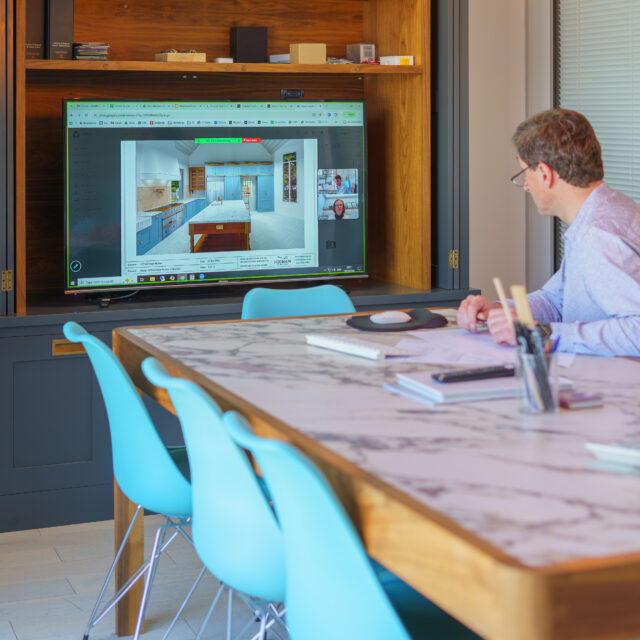
At Higham Furniture, the design process begins with a private 30-minute call with a senior designer, not a sales consultant. The same team that designs your kitchen is connected to the workshop that builds it. Tim Higham is involved throughout. There is no handoff between a sales team and a delivery team.
What Is Included in the Quote, and What Is Not?
Kitchen quotes can vary dramatically in scope. Some include appliances, worktops, and installation. Some cover cabinetry only. Some include some trades and exclude others. Understanding exactly what is and is not covered before you commit is essential to comparing costs accurately.
At Higham Furniture, quotes cover cabinetry design, manufacture, and installation. Structural works, flooring, plastering, plumbing, and electrics are not included unless specifically agreed in writing. We are direct about this from the first conversation, because clients who understand the scope of a project make better decisions. For guidance on the broader kitchen planning process, see Designing a Kitchen That Works for Real Life.
Starting the Conversation with Higham
The process at Higham Furniture begins with a private, no-obligation design call, 30 minutes with a senior designer to discuss your space, your priorities, and your questions. There is no showroom appointment, no sales pressure, and no commitment required.
If you are at the stage of evaluating kitchen makers and want to ask us the questions above directly, book a design call here. We are confident in our answers.

Frequently Asked Questions
How do I know if a kitchen company actually makes their own cabinets?
Ask directly whether they have their own workshop and whether you can visit it. A genuine cabinetmaker will answer confidently and welcome your interest. Ask who builds the cabinets, where, and whether any elements are bought in from external manufacturers. At Higham Furniture, every cabinet is made in our own workshop in Denmead, Hampshire. Nothing is bought in or resold.
What is the difference between bespoke and made-to-measure kitchens?
Made-to-measure typically means standard-sized cabinet units are adjusted or trimmed to fit your space. Bespoke means every element is designed and built specifically for your dimensions, layout, and requirements from the outset. At Higham Furniture, bespoke means exactly that. No standard sizes, no filler strips, no compromise on proportion.
Is it worth visiting a kitchen workshop before commissioning?
Yes, if the maker offers it. A workshop visit gives you direct evidence of construction quality, materials, and craftsmanship that no showroom or photography can replicate. Higham Furniture welcomes workshop visits at our Denmead facility in Hampshire for clients who want to see the work in person.
What should I look for when comparing kitchen quotes?
Compare the scope carefully, not just the headline figure. Check whether worktops, appliances, and installation are included. Ask about cabinet carcase materials (plywood versus MDF), construction method (in-frame versus overlay), and who is responsible for delivery and installation. A lower quote built on cheaper materials or a narrower scope is not a saving.
How important is it to work with the same team from design to installation?
Very. Projects managed by a single connected team, designers who understand what the workshop builds and installers who know the design intent, deliver more consistent results. At Higham Furniture, the design studio, workshop, and installation team work as one. There is no handoff between a sales team and a delivery function.
Written by the Higham Furniture design team. Higham Furniture is an award-winning cabinetmaker based in Denmead, Hampshire, with a design studio in Fulham, London. Tim Higham and his team have been designing and building bespoke handmade kitchens for discerning homeowners across London and the South East.