
Open-Plan Kitchens for London Period Homes
Open-plan kitchens work exceptionally well in London period homes, but only when the design respects the architecture. Victorian terraces, Edwardian semis, and Georgian townhouses each present their own structural constraints: chimney breasts that can’t move, alcoves that demand bespoke cabinetry, irregular ceiling heights, and period features worth preserving. At Higham Furniture, our Hampshire workshop designs and builds bespoke kitchens specifically for these kinds of spaces, where standard off-the-shelf units simply don’t fit. The key to a successful open-plan kitchen in a period home is understanding what the building is telling you, and designing with it, not against it.

Why Are Period Homes Uniquely Challenging for Open-Plan Kitchens?
London’s most sought-after residential streets are lined with properties built between 1780 and 1930. Georgian townhouses in Chelsea and Kensington, Victorian terraces across Fulham, Wandsworth, and Muswell Hill, Edwardian semis in Chiswick and Wimbledon, these are precisely the homes where Higham Furniture works most frequently. And while they are beautiful, they were never designed with open-plan living in mind.
The challenges are specific and consistent:
Load-bearing walls. The Victorian terrace was typically built with a rear wall separating the kitchen from a back reception room. Removing or partially removing that wall, creating the sought-after kitchen-diner, requires structural assessment and often involves RSJ beams to carry the load. The structural envelope constrains what’s possible before cabinetry even enters the conversation.
Chimney breasts and alcoves. Almost every period property in London has chimney breasts projecting into the principal rooms, including the kitchen. These can’t simply be ignored. In a handmade kitchen, a chimney breast becomes an opportunity: a natural frame for a range cooker, a recess for open shelving, or the anchor point for the entire kitchen layout.
Irregular dimensions. Period homes settle. Walls are rarely perfectly plumb, floors are rarely level, and ceiling heights vary across a single room. Standard kitchen units, which assume 90-degree corners and consistent floor heights, fail in these environments. Bespoke cabinetry, made to the precise measurements of the actual space, succeeds where flat-pack cannot.
Ceiling height and original features. Georgian and Edwardian homes often have ceiling heights of 3 metres or more. Victorian terraces are typically 2.7 to 2.9 metres. Both offer opportunities, for full-height cabinetry, for dramatic island units, for large-format windows, that modern new-builds don’t. Period cornicing, original skirting boards, and sash windows must all be considered in the design.
What Kitchen Styles Work Best in Victorian and Edwardian Homes?
The style question is where taste and architecture converge. Period homes tolerate, and often reward, a range of aesthetic directions, but some choices sit more naturally in a 130-year-old building than others.
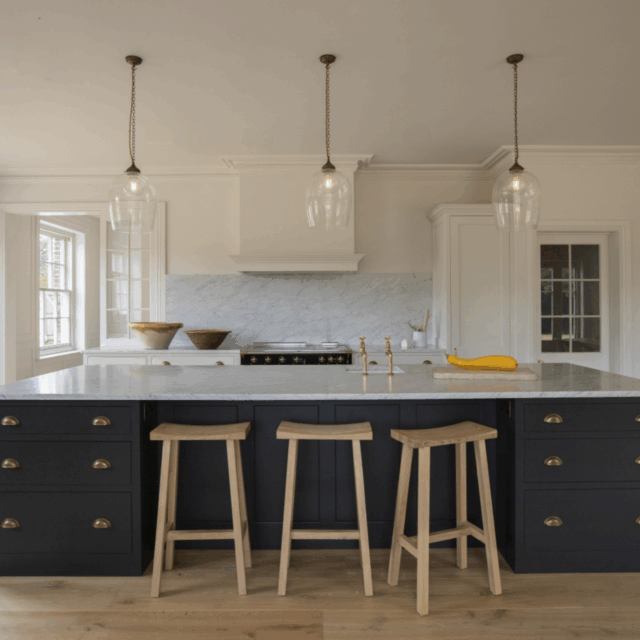
Shaker kitchens are the most versatile choice for period properties. The clean lines, recessed panels, and understated proportions of the shaker style complement Victorian and Edwardian architecture without competing with it. Higham Furniture’s award-winning Putney Painted Oak Framed Shaker Kitchen, which won the British Design & Manufacturing Award at the Designerati Awards UK 2025, demonstrates exactly what a well-executed shaker kitchen looks like in a period London home. The painted finish, the framed doors, and the careful proportioning of the units all speak the same architectural language as the property.
In-frame kitchens are the most architecturally authentic choice for period properties. In-frame construction, where the door sits within the visible frame of the cabinet, is how all quality furniture was built before the twentieth century. In a Georgian or Victorian home, an in-frame kitchen doesn’t just look right; it belongs. This is also the most demanding form of cabinetmaking, and one that Higham’s Denmead workshop has perfected over years of practice.
Handleless kitchens can work in period homes when the design is handled carefully. A sleek handleless run paired with traditional casement windows, original wooden floors, and period cornicing can create an interesting tension between old and new. The key is considered contrast rather than aesthetic clash, and it requires a designer who understands both the contemporary and the traditional vocabulary.
What to avoid: Kitchen ranges designed for new-build or extension contexts, those with very minimal depth, open shelving in lieu of cabinetry, or strong industrial aesthetics, rarely sit comfortably in period homes. The proportions are wrong, and the result feels like a kit kitchen dropped into an irreplaceable building.
If you need more information about whether to work with an interior designer or go directly to a kitchen maker, read our blog post, “Should You Use an Interior Designer or Go Direct to a Kitchen Maker?”
How Do You Design an Open-Plan Kitchen Around a Chimney Breast?
This is the question Tim Higham and his team are asked more than almost any other. The chimney breast is the defining feature of most kitchen-diner spaces in London period homes, and the design decision, whether to frame it, feature it, or soften it, shapes the entire room.
There are three successful approaches:
Frame the range cooker. Position a freestanding or built-in range cooker within the chimney breast recess, with cabinetry running either side. This is the classic solution and works particularly well with a traditional Aga or range-style cooker. The chimney breast becomes the focal point it was always meant to be.
Build alcove cabinetry. Either side of the chimney breast, the alcoves become deep cabinetry runs: pantry storage, wine fridges, built-in ovens, or tall larder units. The chimney breast itself can be finished simply, in painted plaster or with open shelving for books and ceramics. This approach suits homes where the chimney breast is relatively shallow and the alcoves are proportionally generous.
Remove it where possible. In some cases, where the flue above has already been capped and the chimney breast serves no structural purpose, removal creates a clean, flat rear wall. This is the most disruptive approach and requires a structural survey, but it opens up layout possibilities that retention doesn’t.
At Higham Furniture, every kitchen begins with a detailed survey of the existing space, including the chimney breast, the structural walls, the floor levels, and the ceiling heights. The design emerges from that survey. Nothing is assumed. If you would like to avoid expensive planning errors, take a look at our article, “5 Kitchen Design Mistakes That Cost Thousands to Fix.”

What Are the Best Layout Options for a Period Kitchen-Diner?
The knock-through kitchen-diner, created by removing part or all of the wall between a rear reception room and the original kitchen, is the most common renovation in Victorian and Edwardian London homes. It typically creates a rectangular room running the full width of the house, often 4 to 6 metres long, with rear garden access through either a door or bifold doors.
Several layouts perform well in this configuration:
Galley with island. A run of cabinetry along one long wall, a freestanding island at the centre of the room, and a dining table beyond. This works well in rooms of 4 metres or more in width, where there is enough circulation space around the island (allow at least 1 metre on each side, ideally 1.2 metres). The island becomes the informal social space; the rear cabinetry handles all the working storage.
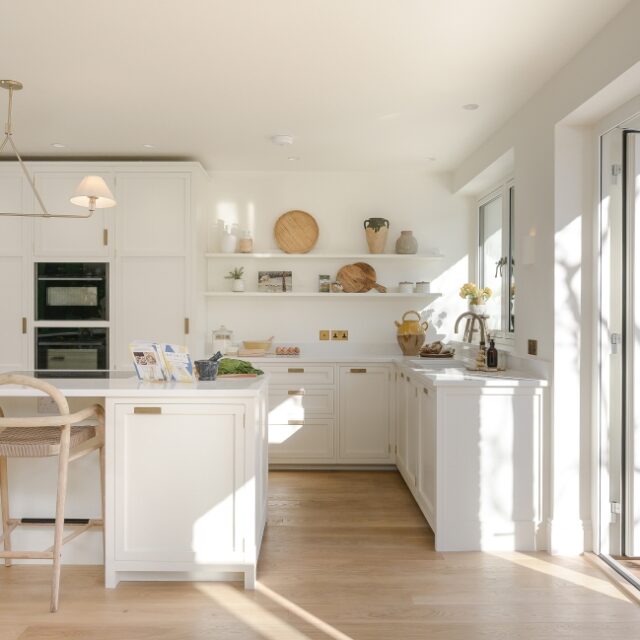
L-shaped. Cabinetry wrapping around two walls, with the corner housing the sink or a prep area. Well-suited to rooms where the structural constraints limit where appliances can be positioned. A well-designed L-shaped kitchen can feel generous even in a relatively compact space.
Single run with pantry. In narrower houses, the standard Victorian terrace through-room is often only 3.5 metres wide, a single run of cabinetry along one wall, with a full-height pantry or larder unit at the end, is both practical and architecturally honest. The kitchen becomes a clearly defined zone within the larger room, rather than a kitchen that bleeds awkwardly into the dining space.
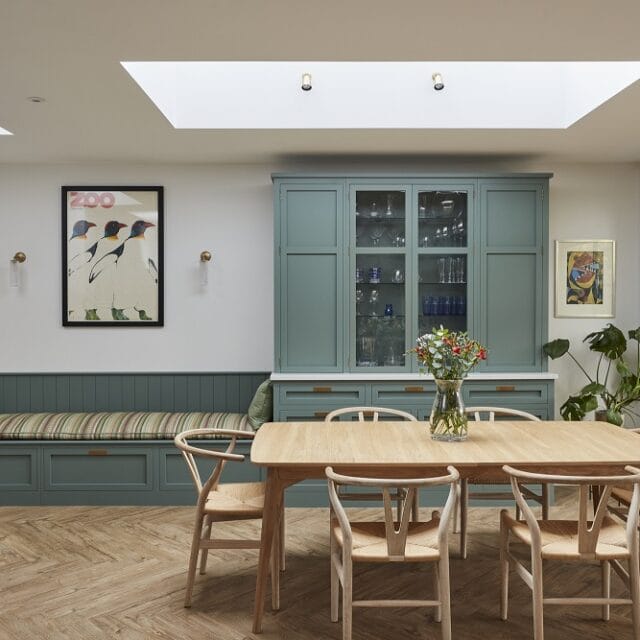
Whatever the layout, period homes benefit from kitchen furniture that acknowledges the room’s height. Full-height cabinetry running to the ceiling, with or without glazed uppers, always looks more intentional and more generous than standard-height units that stop 300mm below the ceiling line.
What Materials and Finishes Work Best in Period London Homes?
Painted finishes are the single most versatile choice for period properties. A hand-painted kitchen in a period home can read anywhere from heritage traditional to quietly contemporary, depending on the colour palette and the door profile chosen. At Higham, every painted finish is applied by hand at the Denmead workshop, a process that produces a depth and consistency that factory-sprayed finishes simply cannot match.
Solid timber, particularly oak, is the most appropriate material choice for period homes. Oak has been used in British cabinetmaking for centuries, and it ages honestly: it doesn’t degrade, it doesn’t off-gas, and it looks better after twenty years than it did when new. Higham’s kitchens are built from oak-veneered plywood carcasses, not MDF, which moves with humidity and fails at joints over time. The framework, where visible, is solid timber.
For worktops, natural stone and solid timber both belong in period homes. Honed granite, unlacquered brass, and aged stone surfaces complement the materiality of Victorian and Edwardian architecture in a way that high-gloss composites don’t. Higham works with clients to specify worktops that sit within the overall design, materials selected for how they age, not just how they photograph.
If you are still deciding on materials and finishes, our guide, “How to Choose the Right Worktop for a Luxury Kitchen,” offers practical advice and inspiration.
Taking the First Step
Designing a kitchen for a period home is not a process that can be rushed or simplified. The variables are too many, the space too specific, and the investment too significant for anything other than a bespoke approach.
Higham Furniture offers a 30-minute design call, by phone, video, or in person at our Fulham studio, as the starting point for every project. It’s not a sales call. It’s a conversation: about the space, the brief, the architectural constraints, and the design possibilities. Many of the people who call us don’t yet know what they need. That is, in fact, the best time to call.
There’s no obligation, no pressure, and no commitment required. Just clarity, before you commit to anything.

Frequently Asked Questions
Can you have a fully open-plan kitchen in a Victorian terrace?
Yes, though the extent depends on the structural configuration of the property. Most Victorian terraces have a load-bearing wall between the rear reception room and the original kitchen. Removing or partially removing this wall requires a structural assessment and usually a steel beam (RSJ) to carry the load, but it is achievable in the vast majority of cases. Once done, it creates one of the most versatile kitchen-diner configurations available in London’s period housing stock.
What kitchen style suits a Victorian or Edwardian home best?
Shaker and in-frame kitchens are the most architecturally appropriate choices for Victorian and Edwardian period homes. Their proportions, construction methods, and material language speak the same vocabulary as the buildings they’re placed in. Higham Furniture’s award-winning Putney Painted Oak Framed Shaker Kitchen is a precise example of how a shaker kitchen can feel entirely at home in a period London property.
How do you deal with a chimney breast in a kitchen-diner?
The most successful approaches are to frame a range cooker within the chimney breast recess, to build alcove cabinetry either side of it, or, where the flue has been capped and no structural purpose remains, to remove it entirely following a structural survey. At Higham Furniture, the design always begins with a survey of the actual space, so the chimney breast becomes a design decision rather than an afterthought.
How long does a bespoke period kitchen take to design and install?
A typical Higham kitchen project runs from 12 to 16 weeks from initial design sign-off to installation. The survey and design phase typically takes 2 to 4 weeks, depending on complexity. Because every kitchen is made to order at the Denmead workshop in Hampshire, the production timeline is specific to each project and confirmed at the point of order.
Is a handmade kitchen worth the investment in a period London home?
In a period home, a handmade kitchen is almost always the better investment. Standard units cannot accommodate irregular dimensions, structural projections, or the ceiling heights that period homes demand. A bespoke kitchen, made to the precise measurements of the space and built to last 30 years or more, is the only approach that does full justice to the architecture, and to the significant investment that a London period property represents.
Does Higham Furniture work across London?
Yes. Higham Furniture works across London and the South East, with particular experience in Fulham, Chelsea, Kensington, Wandsworth, Putney, Wimbledon, Chiswick, Muswell Hill, Kingston, and Surrey. The Fulham design studio is available for in-person design consultations, and the Denmead, Hampshire workshop is open for client visits during the production process.